To begin

In the Name of Allah, the Most Gracious, the Most Merciful
Showing posts with label History. Show all posts

Thursday, 28 March 2013

bookshelf Scavenger Hunt tag

Dear Reader,

The tag was created by TheLibraryofSarah on Youtube and the one I watched was supersushipizza. The idea is to basically find books on your bookshelf(ves) that fit a certain criteria, and there might be something about not using the same book twice. So usually on these sort of youtube tags, one is supposed to make a video response if one is tagged init but it looked like fun and, like Susheela (supersushipizza), I like living "on the edge" and so I've turned this youtube tag into a blogging one. 

1) Find an author's name with the letter 'Z' in it. 
I can only think of one very handsome one for now.

2) Find a Classic 
Easy-peazy.  I've got an entire shelf dedicated to my favourite classics. But for the purpose of this tag, I'm going to choosing the classic I'm reading this month. 

3) Find a book with a key on it
I cannot believe how hard this was. I know that the American cover of Bitterblue, by Kritin Cashore, has keys on it, and that my UK version has keys drawn in it, but has none on the cover.
Then, after much searching, I found a key on this, of all places. And yes that's a key, even if it's attached to a bird.

4) Find something on your bookshelf that is not a book. 
I have several bookmarks, knick-knacks and photos, comfortably residing in and amongst my books. The thing I'm choosing to show you is one that I mentioned before, my teacher's pet 13th birthday present. I keep it as a reminder of how I was a nerd and always will be, (plus he's super cute).    

5) Find the oldest book on your shelf. 
This was a tough one. I had to check a lot of publication dates before I this edition, which came out in 1986. This book originally belonged to my dad until I needed it for a history assignment, back when I was doing my GCSEs. It's been in my room since then.  

6) Find a book with a girl on it. 
I have quite a few of those but I went for one of my favourite books with favourite covers, with a girl on them. 

7) Find a book that has an animal in it. 
I immediately thought of the Disreputable dog in Lireal by Garth Nix. (Only later did Aslan come to mind) 
There is even a dog on the cover. See, right here on the corner.

8) Find a book with a male protagonist. 
At first I thought of Harry Potter but then thought it was a bit cliché and I've already used a HP book once already. So I went for this one instead. 

9) Find a book with illustrations in it. 
All the books in my copy of The Chronicles of Narnia by C.S. Lewis have illustrations in them.
But I've only taken a picture of my favourite illustration from the first book, The Magician's Nephew

10) Find a book with gold lettering. 
Arabic religious books usually have gold leaf on the covers. But these are part of a beautiful series (with the traditional look) in English, published by Darussalam. You must click on the picture to see the intricately coloured patterns better.

11) Find a diary (true or fiction). Well I can one-up you on that becauase I have both. 
Non-fiction
(So far as I can tell, most people who have done this tag have used this book, so I thought I'd follow the trend, for once.)
Fiction   

12) Find a book written by someone with a common name (like Smith). 
Many of the books that I own were written by "foreign" authors or were written long ago. But Nicholas Baker is a common-ish sort of name in  this sense, I think.

13) Find a book that has a close up of something on it. 
I had the choice of  neuron, blood, urea crystal and the coronary artery. I went with blood because I think it will probably gross people out the least.    
           
14) Find a book on your shelf that takes place in the earliest time period. 
The actual oldest time period is in my little blue pocket-version of The Sealed Nectar, which tells the history of the Prophet (pbuh) and begins some time around 570 CE. But it's just such a worn and handled copy that the writing on the cover has completely faded. So I thought I'd go for the next oldest thing, which is Beowulf: an Anglo-Saxon folk tale, first written in Old English in the 10th century. 

15) Find a hardcover book without a jacket. 
This was a gift from my elder brother and it contains all of Jane Austen's novels. Absolutely beautiful to look at but completely impractical to read, considering that fact that it has 1433 pages in it. (I just realised it has gold writing on it too.) 
          
16) Find a teal/turquoise coloured book. 
Though it might look a bit green in the picture, but I assure you dear Reader, it is teal. 
       
17) Find a book with stars on it
I think those little thinks at the top are stars. (Please ignore the shadow of my camera, it was hard to find a place to take a decent picture of it because of its uber mirror-like reflective cover.)
       
18) Find a non-YA book. 
I have plenty of those too but decided to go for the one that I think has the prettiest cover. 
       
For this Bookshelf Scavenger Hunt to continue I tag you, dear Reader. You can make your own tag/response on your blog or youtube or anywhere you like on this internet. Just make sure to leave a link in the comments section below so I can check it out too.

Nida       

Saturday, 2 July 2011

true Conception - the Making of an Idea

Dear Reader,

I recently watched this brilliant movie called Inception. If you haven't already then I definitely recommend that you watch it; and at least twice because it can be confusing at times. But it is amazing, truly inspired and keeps you locked to the edge of your seat. To cut a very long and complicated story short, this film, on the most basic level, is about how most of our ideas come to us in our dreams.  And a few nights ago, I had one of those dreams.   

I don't remember most of the dream, but I remember this one part. There was enormousness body of water. Water stretching as far as the eye could see. And as bright as the brightest sky blue that I've ever laid eyes on. Rising out of water every now and again, were thin columns of rock. I was floating on the water, whether on a rowing boat or a giant leaf, I can't remember which, but it's not really that important. 


In my hand I was holding a rich leather-bound diary and I knew, just knew - somewhere at the back of my mind - that this diary belonged to a bitter-old-foul-mouthed crone. But I also knew that this diary contained the story of how, once upon a time, that bitter old woman was young, smart, shy, innocent and was excited to be sailing to British Occupied India, to a new country, a new culture. It told of a journey of struggle, hardship and heartbreak, that led this beautiful young woman to become an embittered and lonely Lady.     

Image from eu.fotolia.com
In the middle of the diary, was a scene of the young women with a Mughal Prince. They were desperately in love. There was something he said to her, but it was in English and I was trying my best to translate it into Urdu/Hindi because it was originally said in that language. I was having a great amount of trouble because what he had said was quite sensual. And this struggle to translate that sentence became the focus of my dream. It was what I was struggling with as I wrestled myself into conciousness, and woke up thinking about it. 

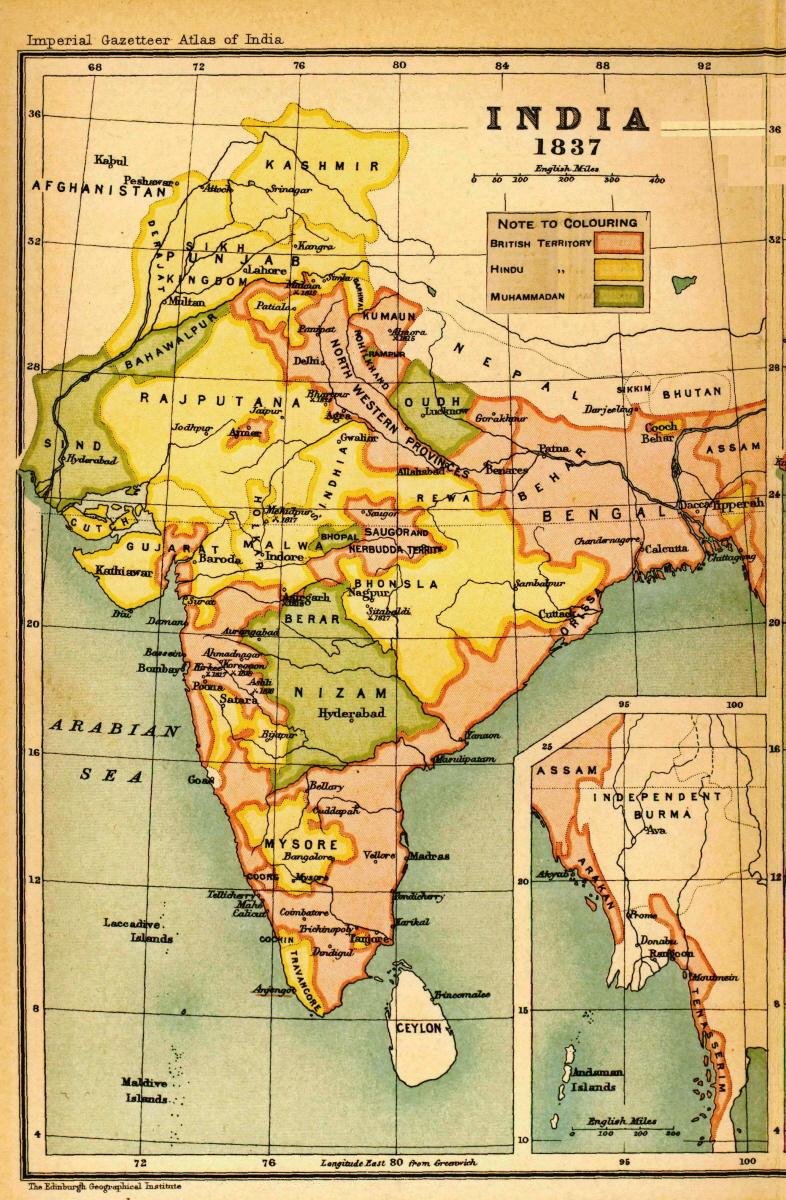
But after waking, I realised that in my dream, I hadn't been reading someone else's diary but actually writing it myself from a character's point of view. That's why the translation was so important. And so my mind began to automatically fill in the gaps of the story: constructing the character of this woman, her name, where and why she was in India, the details of that time period, how the Prince had fallen in love with her, the circumstances of why he couldn't marry her and how exactly he broke her heart, her marriage to a white-fortune-hunter just to spite the Prince, how her husband beat her and tortured her, how her husband eventually died in the 1857 Rebellion

I could not stop my mind from thinking about it. As I went through the daily routine of life, subconsciously my mind was fleshing out the plot and making links and stuff of that sort. I was haunted by this story and I knew I had to write it down some where. But there just wasn't enough of a plot to make it into a novel of it's own. And then click, just like that, I knew exactly what I had to do. 

You see, there is another story that I have planned which is also set in that same time period, the mid-to-late 1800's. This is basically a compilation of letters between two sisters, each telling the other her story. One is Catherine (a.k.a Kitty) who spends the majority of her life in London doing charitable acts and getting involved with the suffrage movement. While the significantly older sister, Camilla,  goes to live in Hindustan with her husband Major James Russell. 
Image courtesy of www.eyefetch.com  
Up until a few days ago, I had Kitty's side of the story thoroughly planned and plotted (hence the working title of the novel was "The Letters of Kitty"). I knew that Camilla's story ran in parallel to Kitty's: where Kitty fought for the rights of women to vote, Camilla would fight against the oppression of the Indian people. Yet, in honest truth, the details, actions and events of Camilla story (as opposed to Kitty's) were still rather ambiguous and fuzzy in my mind. And now here is where the idea from my dream comes in. 

Suddenly, Alhumdulillah, I just knew that Major James Russell had a wealthy but miserable old Aunt who lived in India and James was her only heir (and favourite nephew). So naturally James and Camilla would live with her in her mansion. But the Aunt is mean and bitter and takes an instant dislike to Camilla, making her life miserable too. And after a few years living with her, it is Camilla who find's the Aunt's diary and reads it in secret. She learns all that had happened to the Aunt and why she is the way she is, and relates all that she learns in her letters to her sister, Kitty. Camilla begins to sympathise and understand James' Aunt but just then ... Well, I won't tell you what happens next, for that will be giving away the rest of the story. 

But dear Reader, I did not tell you all this to boast about the stories that I am writing. I tell because I want to give you an example of were ideas come from, how they develop and take on life. Some ideas are brilliant with radiant futures ahead of them. Some are not, forgotten and neglected as soon as they form. Some ideas become best-seller novels, while others become atomic bombs. We cannot pick which idea comes to us. And when it does come, we know not where it might lead. All we can do is choose whether to follow it through. The rest is by the will Allah.

Nida

Tuesday, 8 March 2011

International Women's Day

Dear Reader,

After commenting on a post (by Shelina Zahra Janmohamed) about International Women's Day, I realised I had far more to say than what I wrote in the comment and so I decided to write a blog post about it. Shelina's post basically asked 'which Muslim women inspire you?' Considering this year's theme is Equal access to education, training and science and technology: Pathway to decent work for women, my answer went something like this:

"There are two that I would particularly like to mention, who inspire me for the same reason: their desire to seek and spread knowledge. The first is Aisha (radiallah-hu-anha) the wife of the Prophet Muhammed's (PBUH), and the second is our contemporary Na’ima B. Robert. These two examples just go to show that no matter where you’re from or what time period you live in, knowledge has always been and always will be vital, not only for self-improvement, but also for the progress of society."

You see, I believe that the acquisition of knowledge is the best weapon against oppression. Because, if you are no longer ignorant of your what is going on, if you have knowledge of other cultures and beliefs, you are less likely to be prejudiced and stereotype people, and you are more able to stand up for your rights. In Islam, both men and women are repeatedly encouraged to seek out knowledge, not just about Islam but about all aspects of life. For example, there is a hadith (sayings and doings of the Prophet Muhammed [PBUH]) which states that the Prophet (PBUH) once said:

"If anyone travels on a road in search of knowledge, Allah will cause him to travel on one of the roads of Paradise ... The learned are the heirs of the Prophets, and the Prophets leave neither dinar nor dirham [Arabian currency], leaving only knowledge, and he who takes it takes an abundant portion" Dawud

However, it's not just good enough to accumulate lots of knowledge. You need to do two things once you've gained knowledge:

1) Spread ithoarding knowledge is selfish! Plus, it's no good to anyone if no one knows about it, right? After all how do expect to bring about change if you don't tell people what you know? For example, imagine the first person who invented a specific language. If he/she hadn't taught other people to read or write that language, then the whole of humanity would have been as illiterate as monkeys today and we wouldn't have all these fancy electronic gadgets that we do now. Okay that example is a bit extreme. Well, how about one of the greatest leaders known to mankind, the Prophet Muhammed (PBUH), also known as Al-Mualim - The Teacher. When he received the first revelation from Allah (SWT) "Read! In the Name of your Lord Who has created (all that exists). Has created man from a clot (of blood). Read! And your Lord is the Most Generous, Who has taught man writing by the pen." (Surah Al-Alaq 96:1-5), he didn't just keep it to himself, he first told his wife Khadija (RA) and then the rest of the Arabs and thus began the spread of Islam, through the spread of knowledge.  

2) Use/apply it - knowledge without application is just information. For example, (given my field of study, this is obviously the first example that I will think up) suppose there was a medical student who finished his degree with flying colours, those 5 years of hard work and coffee and effort, finally paying off. Then at the end of it all he decides that he'd rather not get a job as a doctor, that he'd much rather stay at home and languish away his life in front of a T.V. What a waste! He has all the information on how to treat people but decides not to apply it for the good of his fellow man. I know, I know, he has free will and can decide to do whatever he wants with his life, but honestly, what was the point of all those years acquiring that information if he isn't going to put it to use and turn it into knowledge. Because knowledge, is not just about written words on paper, it also encompasses what we learn through our experiences.

Just the same, what we as Muslims learn from the Qur'an and Hadiths, if we apply it to our lives it becomes knowledge.       

But anyway, coming back to the reason I began this post: I leave you, dear reader, with the question: which women inspire you and why? 


Nida

Friday, 4 March 2011

tales of Fairytales

Dear Reader,

The Complete Fairy Tales of the Brothers Grimm All-New Third Edition
I interrupt your daily routine to discuss, of all thing, fairytales. You see, these past few weeks I have felt quite surrounded by them. And they seem to come at me from the strangest places. For example, as last week was the half-term holidays for the primary and secondary schools, my beloved little monsters, I mean cousins, (ranging between 5-12 years old) came to stay around my house. Now, one morning as I was eating breakfast with the youngest one, Codename: Weedy, in Urdu he began telling me a very Grimm-Brothers-esque story he had come up with. It went something like this:


"One day, a Baker made a Ginger-bread man. But the Baker was really fat and so the Ginger-bread man ran away out of fear. While he was running through the forest, he came across a Giant who had a sweet tooth. The Giant said 'I want to eat you, Ginger-bread man.' And just as he reached down to take the Ginger-bread man, a Wolf jumped out of a bush and stepped between the Ginger-bread man and the Giant. He told the Ginger-bread man that he will protect him from the Giant but he should run and hide in the bush just in case. And the Giant did get scared of the Wolf and ran away..." At this point I was thinking 'Awww what a nice wolf, so much for stereotypes' before he continued to the end of his story. "Once the Giant was gone, the Wolf went into the bush and ate the Ginger-bread man!"   

I guess the moral of this story would be not to trust strangers ... or make assumptions about people by how fat they are ...

Princess & The Frog [Blu-ray]Do you, dear reader, see what I mean by 'Grimm-Brother-esque'? I had no idea my little Weedy had such a morbid streak, given his penchant for Disney movies and happy endings, his favourites so far being 'The Princess and The Frog' and 'Cars' (which he has made me watch at least fifty times with him now, to the extent that I now know all the dialogues off by heart).    

This reminded me of the importance that fairytales play in our childhoods, and how much influence they can have on children's lives, especially now with mass media companies like Disney. And because of this, it's important that we allow fairtales to retain they're original role in providng basic lessons like 'do not trust strangers' and not focus on the intanglible 'happily ever after'.    

Relating to this is this youtube video I reacently watched,  by author Jackson Pearce. Most of her videos are quite informative when it comes to writing and she give quite good tips. But in this video she talk about how fairytales adapt and change over time according to what society need them to be at the time.  


Sisters RedI only became interested in Jackson Pearce after I read her book Sisters Red last month (this book is part of my 2011 Reading Challenge, for more info click here or here, your choice). It is essentially a modern twist on the old fairytale, The Little Red Riding Hood. It's a very well written fast-paced book. And though I saw the main twist coimg from a mile away, it still kept me on the edge of my seat and still made me cry. I also love Pearce's use of symbolism and metaphors: from the scar on SCARlett's face, and the weapons of choice, to the actual wolves themselves. An incredibly enjoyable read overall, but not recommened for the faint hearted who do not like blood and gore.  

I'd like to end this post with link to Shelina's blog post about fairytales and breaking out of the stereotypes that girls 'need to be rescued' to find their 'true loves'. Read it. It's really quite interesting and enjoyable  

Nida

Wednesday, 16 June 2010

In Pursuit of Language

Dear Reader,

I'm going to try to keep this one short, as difficult as that is for me!

So, last week something Dr. Finlayson (my pathology professor - who reminds me so much of the lovable Sybil Trelawney, played wonderfully by Emma Thomson) quite rightly said that "studying medicine is like learning a new language." We learn about 2000 new words just in our first two years, which is about the same number of words you would learn if taking a foreign language course. (Aside: shouldn't we getting two degrees then?)

And to begin with, that's exactly what it had felt like; sitting in Monkton lecture theatre (too early in the morning, I might add) with the lecturer speaking in some-other-unknown-language, interspersed here and there with a few English words like "and, the, a". Especially in Dr. Aland's (our anatomy professor) lectures. Anatomy! now there is a subject that requires it's own 'extensively detailed dictionary and correct pronunciation kit'. Instead of saying "to the side and up a bit" you have say something like "Laterally Superior to ... at the Cranial end of the Dorsal root ganglia..." etc.... If you can understand that upon first hearing it then you deserve an award. For a detailed description of our Anatomy session's and the (duh duh duuuuhhhh) Dissection Room, I refer you to a blog by my poetical friend.          

A Confession: (haven't had one of those is some time) I've always found the history of language fascinating. Being multilingual as I am, I'm always surprised to find connections between different words. For example, pineapple is the same in French and Urdu! Often the etymology of words, like ananas (pineapple), can be quite interesting. (It's one of the things I really like about a little wiki here! To think someone actually goes to all the trouble of finding where words originate from. So next time you  look  up something on that site, make sure you read the etymology of the word.)
 

Anyway, I've noticed that language tends to travel with people. I believe Alexander the Great was one of the biggest culprit for this phenomenon. Honestly, he went all over the place with a war hammer in one hand, (I'm not quite sure what was in his other hand - probably the reins of his horse), spreading destruction, disease and language in his wake. Built himself quite an empire, he did. It's a shame he never got to see the aftermath of his work. (Make sure you click on the map and see the bigger, more coherent, version.)

 
The next big one after dear Alexi, has to be The Crusades. They lasted lasted over a thousand years, killed millions upon millions of people, and some people (quite wrongly in my opinion) believe they are still going on today. The crusades were not only a collision of swords on the battle field but also a collision of cultures. It's not a very new concept for most of us now in our modern-media-driven-lives, but it was definitely new for those poor farmers-turned-crusaders back in the 1st millennium. Looking back, I can't help notice the stark contrast between these two opposing sides (that happen to have the same origin, I might add). While Europe was going through it's 'Dark Ages', the Middle Eastern Nation happened to be experiencing, what we now term, the 'Islamic Golden Age'. Talk about a juxtaposition (look up it's etymology!).

I think I've gone on for long enough now, I'm pretty sure you don't want a history lesson right now. And anyway, I must go and have lunch. I'll leave you to contemplate your own use of language.

(Note: I need to blog about the nerd-fighters and John Green at some point, preferably after the dreaded exams)   

Nida

P.S. - What do you think of the change in the appearance? Let me know, leave a comment.