Dear Reader,

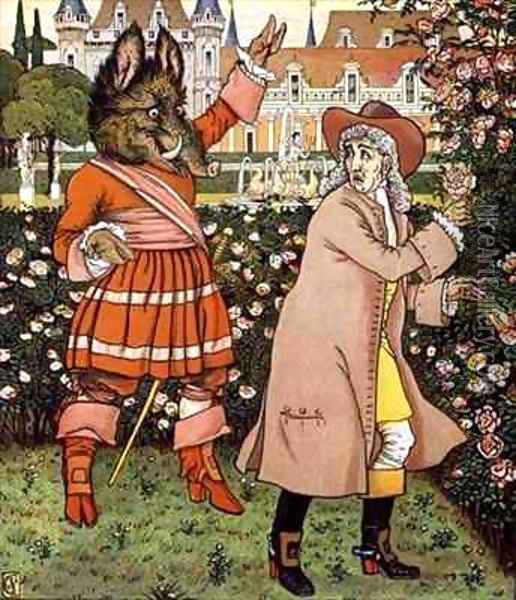
A bit of history now. In 1756, Jeanne-Marie Laprince de Beaumont (aside: that is one cool name) set the foundation for the story we normally think of today when we talk about The Beauty & The Beast. It follows the tale of a ship-owning merchant who becomes bankrupt, has to leave his home in the city and move to the countryside with his 3 daughters. Once they become accustomed to their provincial life they hear news that one of the merchant's ship has returned. So the father heads back to the city. On his way home however, he gets lost in a forest and comes across an enchanted castle where he is taken in and cared for. The next day, on his way out of the castle grounds, he picks a beautiful rose for his youngest daughter Beauty (that's Belle in French), who asked for nothing more than some rose seeds as gift from the city (her elder sisters had asked for fancy clothes and fine jewellery, none of which the father was able to obtain).
 This is when he encounters the enraged Beast who owns the castle. The Beast claims that in return for all his hospitality the merchant was stealing from him. The merchant as for forgiveness explaining about his three daughters and how he had not been able to fulfil the humble wish of his youngest. The Beast takes some pity on him and offers him a choice: he (the Beast) would let him go now unharmed but in 7 days time, the merchant can either return to this castle and be his prisoner or he can send one of his daughters in his stead. So the merchant returns home and tells his daughters what happened to him, at which point Beauty decides that she must be the one to return as it was her fault her father picked the rose.
So a week later, Beauty arrives at the enchanted castle where she is treated like a princess and the Beast almost immediately falls in love with her. She spends several months in the Beast's company and they grow to become good friends and she is able to see beyond his appearance to the heart of gold within. But every evening after dinner, the Beast unfailingly asked Beauty if she would marry him. And every evening she would refuse. Eventually she grows homesick and asks the Beast if she can see her family, so he lets her go back to them for a week, no more. But her jealous older sisters trick her into staying a day longer. When she finally arrives back to the castle, she sees that the Beast is dying and she cries over his body saying how sorry she is for being late and how much she loves him. Then, abracadabra, he is alive and healthy and transformed into a handsome prince. And they live happily ever after ... or so we think.

That is generally what happens in the 1756 version. However, the earliest recorded version of La Belle et la Bête was published in France in 1740 and was written by Gabrielle-Suzanne Barbot de Villeneuve. Only, in her version there where plenty of sub-plots, featuring a wider cast of characters including good and evil fairies, as well as an elaborate back story for the Beast. Basically, Leprince de Beaumont's tale was a rather watered down version of Barbot de Villeneuve's story. All that aside, when I think about it, I'm actually not surprised that this fairytale (in which the ordinary girl saves the ugly prince by breaking his curse with but a few tears) was written by a woman, as opposed to most Grimm and Anderson fairytales where the handsome princes usually do all the rescuing of damsels.

Despite the many variations and different versions in the 150 year or so since it's first publication, it was actually the Leprince de Beaumont's version of the story that's been popularized by Disney in their Oscar-winning 1991 animated film. Though, the creators at Disney couldn't help but add a few typically-Disney changes: the several musical numbers, a humours cast of conspiring servants, Beauty/Belle no longer being the daughter of a merchant but that of an inventor and, most importantly, a villain who happens to be beautiful on the outside but ugly on the inside to present the perfect metaphorical contrast to the the Beast. This cartoon film was how I first came across the fairytale and is the depiction that stayed with me through-out my childhood. It can still make me fall in love with the story all over again, every time I watch it.


However, in this TV show, Belle is neither the daughter of a merchant nor an inventor, but rather that of a Lord/King (it is slightly unclear). She also happens to be far more plucky and spirited than one would expect from a book-worm princess, i.e. she wants adventure, the chance to play hero. And the Beast ... Well, in this incarnation the part is taken up by the long-standing shady character of Rumplestiltskin (a Grimm brother's fairytale in and of itself). But he is a complexity, and to give you even the smallest measure of understanding of him would require me to explain the entire series. Which I'm not going to bother with. But I will say this, the choice of using this more-than-usually conniving version of Rumplestiltskin to play the misunderstood Beast was a brilliant opportunity of character development and a very clever move by the creators/writers Edawrd Kitsis & Adam Horowitz.

I would also like to point out that even the very popular classic Jane Eyre by Charlotte Brontë has all the essentials bits of The Beauty & The Beast, but without any explicit magic/enchantments. Though Jane Eyre is not a beauty, she definitely has a beautiful, spirited soul and a learned feel about her. Mr.Rochester is positively beastly towards Jane, at the beginning at least, which is one of the reasons Jane is so attracted to him. Also, he is said not to be very handsome, with a heavy brow and penetrating gaze, and he compares Jane to many different magical apparitions. And of course half way through the story, Jane leaves Mr.Rochester, during which time a tragedy befalls him and when she returns, he is pretty much on the edge of life.
However, of all the different versions of B&B that I have read or seen (even though I love Jane Eyre as a stand-alone novel), my favourite version of this fairytale is Beauty by Robin McKinley, which was first published in 1978. This novel is most like the Leprince de Beaumont's version of the story, though it puts a lot more emphasis on Beauty's feelings and the magic of the enchanted castle. Plus, to the best of my knowledge, McKinley was the first to depict Beauty as a bookish girl, whom the Beast surprises and pleases with his vast Library. I must have read this novel over 5 times since I first discovered it about 6 years ago.
I dream of, one day InshAllah, passing on this much-loved and well-worn book to my daughter (or son, depending on which I have first, after all I'm not biased when it come to which gender should/should not read fairytales) and allowing her (or him) to discover the meaning behind the fairytale. Because, in the end, I heartily believe in the essential message that is integral to the basic plot of this tale: that everyone deserves love, no matter what they might look like; and that we should not judge people's hearts because of their appearance.
If you have been following my blog for some time, you'll undoubtedly be aware of my obsessive love for fairy tales. If not, then I present you with Exhibit A and Exhibit B as just a few examples. But today I want to talk a bit (or a lot, according to some) about my favourite of all fairy tales, most popularly known as The Beauty & the Beast.
There are a few tales that seem to resonate through time in all kinds of different cultures: the tragedy of two 'star-crossed lovers', for example, that variously go by the names of Heer & Ranja, Laila & her Majnu, Juliet & Romeo, Sohni & Mahival or Katniss & Peeta, though that is another blog post in and of itself. Another such timeless tale is that of a beautiful girl, forced to stay with an evil/ugly/beastly man, whom she eventually falls in love with so he lets her go, but she cannot bare being parted from him for long and so she returns to him.
The oldest story I can find that follows this pattern is that of Persephone (that's pronounced per-SEF-o-Nee) and Hades, an ancient Greek myth. Hades is the King of the Underworld and Lord of the Dead, but he falls in love with Persephone, the daughter of Zeus and Demeter (the goddess of the harvest and grain). Yet Persephone has many suitors so her mother hides her away in the forest. One day, overcome with desire for her and wanting a companion to remove his loneliness, Hades rips open the earth and kidnaps Persephone, taking her back to the underworld, where she becomes his Queen. There, he showers her with all the riches of the earth: gold, silver, diamonds and all other gems.

But Persephone is still unhappy, and misses her mother greatly, who mourns her daughter's loss so much that the earth is plunged into a cold and frigid winter. Seeing Persephone upset, and wanting only to make her happy, Hades lets her go back to the surface. Her return to Earth brings with it spring, with all its flowers and blooms. Then at the end of harvest time, Persephone returns to the underworld, to Hades, and the world goes into winter again. Most versions say that she only returns because Hades tricked her, a few say she returns out of love for him. I'd like to believe that in her time in the underworld, she grew to love her morbid husband. But then again, I am one of those "glass half-full" type of people.
A bit of history now. In 1756, Jeanne-Marie Laprince de Beaumont (aside: that is one cool name) set the foundation for the story we normally think of today when we talk about The Beauty & The Beast. It follows the tale of a ship-owning merchant who becomes bankrupt, has to leave his home in the city and move to the countryside with his 3 daughters. Once they become accustomed to their provincial life they hear news that one of the merchant's ship has returned. So the father heads back to the city. On his way home however, he gets lost in a forest and comes across an enchanted castle where he is taken in and cared for. The next day, on his way out of the castle grounds, he picks a beautiful rose for his youngest daughter Beauty (that's Belle in French), who asked for nothing more than some rose seeds as gift from the city (her elder sisters had asked for fancy clothes and fine jewellery, none of which the father was able to obtain).
So a week later, Beauty arrives at the enchanted castle where she is treated like a princess and the Beast almost immediately falls in love with her. She spends several months in the Beast's company and they grow to become good friends and she is able to see beyond his appearance to the heart of gold within. But every evening after dinner, the Beast unfailingly asked Beauty if she would marry him. And every evening she would refuse. Eventually she grows homesick and asks the Beast if she can see her family, so he lets her go back to them for a week, no more. But her jealous older sisters trick her into staying a day longer. When she finally arrives back to the castle, she sees that the Beast is dying and she cries over his body saying how sorry she is for being late and how much she loves him. Then, abracadabra, he is alive and healthy and transformed into a handsome prince. And they live happily ever after ... or so we think.

That is generally what happens in the 1756 version. However, the earliest recorded version of La Belle et la Bête was published in France in 1740 and was written by Gabrielle-Suzanne Barbot de Villeneuve. Only, in her version there where plenty of sub-plots, featuring a wider cast of characters including good and evil fairies, as well as an elaborate back story for the Beast. Basically, Leprince de Beaumont's tale was a rather watered down version of Barbot de Villeneuve's story. All that aside, when I think about it, I'm actually not surprised that this fairytale (in which the ordinary girl saves the ugly prince by breaking his curse with but a few tears) was written by a woman, as opposed to most Grimm and Anderson fairytales where the handsome princes usually do all the rescuing of damsels.

Despite the many variations and different versions in the 150 year or so since it's first publication, it was actually the Leprince de Beaumont's version of the story that's been popularized by Disney in their Oscar-winning 1991 animated film. Though, the creators at Disney couldn't help but add a few typically-Disney changes: the several musical numbers, a humours cast of conspiring servants, Beauty/Belle no longer being the daughter of a merchant but that of an inventor and, most importantly, a villain who happens to be beautiful on the outside but ugly on the inside to present the perfect metaphorical contrast to the the Beast. This cartoon film was how I first came across the fairytale and is the depiction that stayed with me through-out my childhood. It can still make me fall in love with the story all over again, every time I watch it.

Most recently (in late 2012, in fact) I watched a very different take on the classic tale in ABC's fantasy drama Once Upon A Time. There's a continuation of many themes from the Disney film, for example:
- Belle's outfits, especially the yellow ball gown in which we first see Belle,
- obviously her name is also "Belle" (though that may also be a nod to the story's origin),
- a chipped teacup that has symbolic meaning,
- Belle's fondness for books and libraries is also in evidence,
- as well as the single red rose.


I would also like to point out that even the very popular classic Jane Eyre by Charlotte Brontë has all the essentials bits of The Beauty & The Beast, but without any explicit magic/enchantments. Though Jane Eyre is not a beauty, she definitely has a beautiful, spirited soul and a learned feel about her. Mr.Rochester is positively beastly towards Jane, at the beginning at least, which is one of the reasons Jane is so attracted to him. Also, he is said not to be very handsome, with a heavy brow and penetrating gaze, and he compares Jane to many different magical apparitions. And of course half way through the story, Jane leaves Mr.Rochester, during which time a tragedy befalls him and when she returns, he is pretty much on the edge of life.
However, of all the different versions of B&B that I have read or seen (even though I love Jane Eyre as a stand-alone novel), my favourite version of this fairytale is Beauty by Robin McKinley, which was first published in 1978. This novel is most like the Leprince de Beaumont's version of the story, though it puts a lot more emphasis on Beauty's feelings and the magic of the enchanted castle. Plus, to the best of my knowledge, McKinley was the first to depict Beauty as a bookish girl, whom the Beast surprises and pleases with his vast Library. I must have read this novel over 5 times since I first discovered it about 6 years ago.
I dream of, one day InshAllah, passing on this much-loved and well-worn book to my daughter (or son, depending on which I have first, after all I'm not biased when it come to which gender should/should not read fairytales) and allowing her (or him) to discover the meaning behind the fairytale. Because, in the end, I heartily believe in the essential message that is integral to the basic plot of this tale: that everyone deserves love, no matter what they might look like; and that we should not judge people's hearts because of their appearance.
Nida


 to this, which is now finally out. It is something that can't be help it, I'm a compulsive completionist.
 and
 .

 as well as
 , with some
 being cut off at the bottom of the picture.

 and the
 , followed by the DVD of my Favourite BBC adaptations of Classics, including:
 ,
 ,
 and
 .

 and
 .

 ,
 and
 .
 's best works.

 and
 . I have to admit, I haven't much grown out of these books in all these years.
 's
 books, the under-appreciated
 , and
 for obvious reasons.

 .

 (in green),
 (in the stripped blue) and my copy of the
 .

 use to reside, but it was burrowed by an old friend and never returned. :'(
 . Sorry

 has been transferred, to the top of my big wardrobe to have a teeth and claw battle with...

 's dragons. Who will win this epic dual of fantasy vs. horror in the

 of

 at the heart of it all. If you have been following my blog for long enough, you'll remember that
 , a biography of the Prophet Muhammed (PBUH).