To begin

In the Name of Allah, the Most Gracious, the Most Merciful
Showing posts with label my Stories. Show all posts

Monday, 29 October 2012

what Makes a Heroine?

Dear Reader,

Since I started thinking about the quartet I'm currently working on, Chronicles by Anamika, which is to say for about 6 years now, I've often found myself asking this question: "what makes a heroine?" It's also the question that Jane Austen explored quite well in her first complete novel, Northanger Abbey, especially in the first chapter: "No one who had ever seen Catherine Morland in her infancy would have supposed her to be born a heroine."   

To answer this question, I've often turned to my favourite stories, looking at the characters in particular and analysing why I liked them so much. That is how I formed my list: 'Favourite Fictional Heroines (not including Fairytales)' which I plan to share with you today. Aside: this list is not ranked by favourite first, but rather in order of how I read them.  

Matilda by Roald Dahl:
The first book I ever remember reading was a picture book by Roald Dahl called The Enormous Crocodile. From then on, my childhood was littered by his books, including the famous Charlie and the Chocolate Factory. But the one that stayed with me the most was obviously Matilda. As a child, she was the one I identified with the most: she had this endless thirst for knowledge and loved to read. Though, Matilda also had many qualities that I aspired towards: she was spunky, mischievous, always did what she believed was right and just, and had the power to move things with her mind! You, dear reader, can probably see why this appealed to the shy little girl that I was.    
Illustration of Matilda by Quentin Blake
Lucy Pevensie from The Chronicles of Narnia by C.S. Lewis:
I first read The Lion, The Witch and The Wardrobe back in year five with the rest of my class. It took me another year or two before I found the rest of the Narnia books and fell deeply in love with them. Of the two Pevensie sisters, I only liked Susan because she was 'the voice of reason', cautious and practical (much like myself), but it was Lucy who really found a way into my heart. Looking back now I've realised why that was. Lucy was the embodiment of childhood innocence, she was imaginative and trusting and completely loyal to her family and friends.  

Miranda Otto as Eowyn,
The Shieldmaiden of Rohan
Éowyn daughter of  Éomund from The Lord of the Rings by J.R.R. Tolkien:
Back in 2001, when I was just on the brink of my teenage years, my cousin (who is 8 years older than me), took me and my elder brother to the cinema to watch The Lord of The Rings: The Fellowship of the Ring. She was already a big fan of the books and told me to read them as well. It goes without saying that I'd read the entire trilogy and The Hobbit before the next film was released a year later. There aren't actually many female characters in Tolkien's works, but the few that there are, are all rather memorable. My favourite of the lot is definitely Éowyn, though she is not my most favourite character from the trilogy (that would be Gandalf and Sam Gamgee). The reason why I like Éowyn so much (and on whom I somewhat modelled my own character Sharon) is because she is brave and she wants to prove that women can do so much more than just take care of hearth and home, and that when it comes to courage, size and strength doesn't matter. Plus, she says the simplest things in a very interesting manner: "I have waited on faltering feet long enough. Since they falter no longer, it seems, may I not spend my life as I will?" (I wish people still spoke like that *sigh*). 

Sally Lockhart from The Sally Lockhart Mysteries by Philip Pullman:
While Philip Pullman is better known for His Dark Material trilogy, I personally much prefer The Sally Lockhart Quartet. I actually found these books in a neglected corner of my secondary school library, when I was 16 and was working there as a library assistant. I was just beginning to develop my love for history and all things Victorian, so these books (which are set between 1872 and 1882) greatly appealed to me and were also written in modern English, making them easy reads. So, when we first meet Victoria (Sally) Lockhart, she's a feisty 16 year old, albeit one in mourning for her beloved father and thoroughly determined to solve the mystery surrounding his death. Then over the years (and books) she goes on to become a successful businesswoman, then a single mother trying to juggle her work, an old nemesis and her personal life, when all the while she's also been battling against the stereotypes of the British Victorian Society. This unconsciously taught me an important lesson in writing, that heroines are much more interesting when they don't conform to society's view of a 'typical woman'.  And being a bit of a nonconformist at heart, these books gave me the courage to just be who I am and not care much for how inconsequential others saw me.     

Lirael by Garth Nix
I read The Old Kingdom Series (aka The Abhorsen Chronicles) just a little while, maybe only a few months, after The Sally Lockhart books. Anyway, in the very north of the Old Kingdom lives the Clayr, who are all fair-haired women and all are Seers. Amongst the Clayr is dark-haired Lirael, a misfit since her birth. The only place she finds sanctuary is in the mysterious and convoluted Library, where she works as a librarian and is usually accompanied by her unusual companion: the Disreputable Dog. But soon enough her adventures in the Library lead her to begin a journey that takes her all the way across the Old Kingdom, in which a dark evil is rising once again. And it is in the murky waters of Death itself that she finally begins finding her identity. The last time I read Lirael was about six years ago now, and considering the hundreds of books I've read since then it is only understandable that I no longer remember much of the story or the names of other characters in this one. But the fact that I have a lasting impression of Lirael in my mind and still see her as being one of my favourite heroines, is testament to the fact that she was such a well written character. 

Sabriel & Lirael by Claire Lenth
Jane Eyre by Charlotte Brontë:
When I was studying for my A Levels in English Literature (as well as Biology, Chemistry, Maths and History), I was also going through 'my Classics phase'. That's when I read Jane Eyre for the first time, as well as all the other books by the Brontë sisters (save for Villette, since my local library didn't have a copy). There are so many reasons why the character of Jane Eyre is such a brilliant a heroine that I'm not sure where to start. I suppose it'll only be true to Jane if we use her own words: "Do you think because I am poor, obscure, plain and little, I am soulless and heartless? You think wrong! - I have as much soul as you, an as much heart!" Actually I think this quote by an 'anonymous' reviewer, also captures her just right: "The book revolves around the trials and tribulations to which she [Jane] is subjected. Jane is headstrong and fights for what she believes in; she stands up for her rights and retaliates when harassed. She can be passionate and determined." I would like to add that what I liked best about Jane Eyre was that when she finally married Mr. Rochester, they were completely equal, both in terms of wealth and status as well as their dependency on each other.  

Anne Elliot from Persuasion by Jane Austen:
Sally Hawkins as Anne Elliot
from the 2007 ITV adaptation of
'Persuasion'
(Also a part of my 'Classics phase'.) Of the six complete novels that Jane Austen wrote, Persuasion is my favourite. It's all about second chances and persuading each other to not give up on hope and love, even when there is little chance of it. And as for Anne Elliot, the protagonist, I feel a lot of empathy towards her. Her family, and some of her friends, are very negligent of her and constantly under appreciating her kindness, compassion and good sense. They never miss an opportunity to impose their arrogant aristocratic values on her. Anyway, what better way is there to describe Anne Elliot than with the words of Captain Wentworth (the 'hero') "[There was] no one so proper, so capable as Anne ... Her character was now fixed in my mind as perfection itself, maintaining the loveliest medium of fortitude and gentleness." So basically I really look up to Anne Elliot, she seems to embody all the values that should be in a down-to-earth young woman. On a side note, her personality greatly reminds me of my mother.    

Margaret Hale from North & South by Elizabeth Gaskell (both my favourite book and author):
Another amazingly-realistic and moving book written in the Victorian Era. I won't say too much about Margaret today because I plan to write an entire review post about this book in the near future, Inshallah. I will say however that one of the things I like best about Margaret Hale and Mr. Thornton is the way they both change and develop into better, less stubborn, people over the course of the novel.

Lady Fire from Fire by Kristen Cashore (the only American author on this list, funnily enough):
It took me only two and a half days to read this book, that I had purchased on the day of its release in the UK, which happened to be only a few years ago (2009). What kept me so hooked on this book was not only its fast paced and engaging plot, but also the way that Cashore uses the character of Lady Fire as a medium through which to explore broad and thought provoking themes. For example, the struggle between control and freedom, which was embellished with the exploration of the idea that hardly anyone is either entirely good or entirely evil, everyone has their own shade of grey (ETA - no reference any other rather "popular" book), as well as the concept that if one has power, it is so very easy to abuse it. I hope to convey similar themes in my novels, and the fantasy genre seems to be a really good way to go about doing that.    
UK book cover
Elinor Dashwood from Sense & Sensibility by Jane Austen (again): 
Surprisingly enough, I didn't get around to reading this one until only 2 years ago. I'm not exactly sure why that was, but I'm sure it no longer matters since I have finally read it. Simply put, I like her because Elinor Dashwood is 'sense' personified. Though she also has a great deal of patience, fortitude and faith in her too. To this effect, she is described quite well by Austen in Chapter 1: "Elinor, this eldest daughter whose advice was so effectual, possessed a strength of understanding, and coolness of judgement, which qualified her, though only nineteen, to be the counsellor of her mother ... She had an excellent heart - her disposition was affectionate and her feelings were strong; but she knew how to govern them."  There is not much more that I can add to that. 

Hermione Granger from The Harry Potter Series by J.K. Rowling:
Emma Watson as Hermione
Granger (2003) 
I've already explained in this post why I read the Harry Potter books only recently, so I won't go through that again as it might be boring for you, dear reader. When I read about Hermione, especially in books 1 through to 4, I kept thinking back to myself as a teenager. I was a complete nerd, with goofy front teeth (and braces later on, though I didn't acquire my glasses until more recently), spent lots of time in the library, had a penchant for answering questions and getting them right (though I'm not nearly as clever as Hermione), got along quite well with most teachers, was enthusiastic about learning (although not so much about exams), just a tad bit bossy with my friends and brothers (okay, okay, really bossy), and was very neat, tidy and super organised (still am). Furthermore, among many other more unpleasant things, I was often called 'teacher's pet', so much so that for my 13th birthday one of my friends, Codename: Guji (who up until recently possessed my Inkheart trilogy) gave me a teddy-dog with a graduation cap and the words 'teacher's pet' written on it (I still have it sitting among my books). So when it came to Hermione, not only did I feel sympathy for her, but I could very much relate to most of what she went through (except her crush on Ron, as I didn't have a friend like him). But there were also many things that I learnt from Hermione; one of which is that a girl can be adventurous, brave and beautiful while still remaining proud of being a nerd. It's one of the things I like best about her: she has integrity and dignity, as she is not willing to sacrifice her intelligence, or any part of herself, to be more likeable to other people, especially boys.  
       
Though these next two are not technically heroines, I still think they deserve a mention among my favourites. 

Angela from Eragon by Christopher Paolini
Eragon is a book that holds a rather special place in my heart, since it was the reason that I first properly spoke to Codename: Pixie, who is now one of my closest friends. This was about 9 years ago, so we have been friends a very long time. You know, dear reader, eccentric Angela rather reminds of Pixie, if she were 40 years old that is. If you want to know what sort of woman Angela is, all you have to do is read page 179 and 180 of Eragon, and you'll also understand why I love her so much.(They are very much the same reasons why I love Luna Lovegood).  

Professor Mcgonagall from The Harry Potter Series (again): 
There are plenty of amazing/noteworthy female characters in the Harry Potter books that I absolutely adore, but I thought that I'll only mention Minerva Mcgonagall in this post. Professor Mcgonagall is all about discipline, on the outside at least, though she is caring and warm enough that no one really hates her. And she also has this way of commanding peoples' respect, including my own. As tough and no-nonsense her exterior is, she has a very soft heart on the inside that, on the rare occasion, makes itself known: for example, in those first few pages, of the first book, when Professor Mcgonagall's eyes tear up, when she hears about James and Lily Potter's death ... *sigh* ... or when she becomes rather emotional when Harry & Ron say that they want to go visit the petrified Hermione. Actually, I really want to know Minerva Mcgonagall's back story, after all, we got to know Professor Lupin's, Professor Snape's and even Professor Dumbledore's. I want to know what she was like as a talented student at Hogwarts, then as a young woman and how that led to her becoming a Professor. And yet, I have a feeling that her story can only be bittersweet.          

Dame Maggie Smith as Professor Mcgonagall

Anyway, it has not escaped my notice that many of my favourite heroines (7 out of 11) are of the 'bookish' sort (i.e. they really like reading). But that is probably because I myself am bookish and so can relate really well to those kind of girls/women. Moving on. So, to answer the question 'what makes a heroine?':
  1. I've learnt that a heroine must be relate-able, so the reader can connect with her
  2. While she should still symbolise something 
  3. She must have the strength, will and determination to shoulder the story's plot  
  4. She doesn't have to conform to the norms of society
  5. She should be true to herself and I should make sure that her characteristics are consistent 
  6. She must also be likeable so the reader doesn't despise her (which may put some people off)
  7. She can be a medium through which heavy themes can be explored
  8. She should grow and develop into a better person through the course of the novel. 
  9. And finally, she should be well written and memorable.
Nida

Monday, 24 September 2012

what Next?

Dear Reader,

So now that I have relatively more time on my hands, I've been doing a lot of thinking. And, of course, this has lead me to the question "what next?" I'm a bit of an obsessive planner, so it goes without saying that I pretty much have my life divided in short term and long term plans. 


The long term plans are all the usually, typical, boring stuff: get training, get a job, find a literary agent, get married, move to different country, go on hajj, so on and so forth. However, it's the short term plans that are much more interesting: what I plan to do with the time I have between now and when I start training.     


Well firstly, as you can probably tell by my previous post, that I plan to  do a lot more sketching and painting. I'm also working on the first novel from my fantasy seriesBook 1: The Legend of Sharon, which I hope to complete by the end of this year Inshallah. But, unfortunately, I've been having some difficulty writing Chapter 5, which is turning a lot longer than I had originally planned. I've already split the main events over two chapters, and splitting it further would only make the plot drag. Oh well, I'll finish the Chapter as it is, then come back to it after the whole thing is finished and change as needed.      

I also plan to spend a lot more time with my mum, get in on some of that precious mother-daughter bonding time that I'd been missing so much, which isn't all that surprising as my wonderful mummy is also one of my best friends. We plan to experiment with all sorts of new desserts and she wants to teach me to make some traditional foods like gol-gappay. It's a bit cold now to do much gardening, but we still have some cherry tomatoes ripening in our vegetable bed, so they also require some looking after. And me and mum have been doing a lot of catching up on Pakistani and British TV dramas that we watch together, especially since I had to put all that on hold as I completed my thesis. It's really fortunate that the new series of Downton Abbey just started, which gives me something to look forward to every Sunday.          

But what I want to do most now, is simply just READ. The last fictional book I read was Fahrenheit 451 by Ray Bradbury, and that was back in July. I've missed reading, so I'm really looking forward to having time to just sit back and read for the pleasure of it. I have quite an extensive list that I want to get through by the end of this year, but I'll only give you, dear reader, some of my most anticipated titles from the list:

  1. The Anthologist by Nicholson Baker
  2. Raven Boys by Maggie Stiefvater
  3. The Mark of Athena by Rick Roirdan
  4. Sapphire Blue by Kristen Geir
  5. The Named by Marianne Curley
  6. The Night Circus by Erin Morgenstern
I was going to write a review about Fahrenheit 451, but I think that this video (part 1) and this one (part 2 and 3) do a much better job of explaining and exploring the book that I could ever do.

Nida


Sunday, 1 July 2012

six Styles of Writing, and Me

Dear reader,

1) When is comes to writing - a thing that I do a lot of - the easiest form for me is, believe it or not, poetry and verse. Subhanallah, sometimes I find that even my thoughts are following some sort of rhyme scheme or meter, trochiac pentameter (with a lot of causurae) seem to be my subconcious' favoured style. (Aside: if you didn't understand anything from the last sentence, click on the links or over here.) When I confessed this to my mother the other day, she gave me such an odd look, as if I was a person she didn't recognise. Kind of heart breaking, given that she is the person I love second most in the world. But, in order to show you, dear reader, how natural poetry is to me, I present to you a poem that I wrote about Writing Poetry

Sometimes the most beautiful things
Are those with no inherent cause
Are spontaneously inspired
A single thought that brings
Words upon words without a pause.

So that is when these poems
Emerge and grow out of my brain
They take on life and flutter around
And align like gems upon a chain
But in my mind they cannot remain,

So I cease and caress the words
Nurture those seeds into a stem
Then my pen begins to caper
As I coax the words onto paper
That was bland and lifeless without them... 


2) The next style of writing, that I suppose I'm modestly good at, is description, in particular scenic description.I believe that description forms the majority of a piece of fictional writing. Without it, the piece would be only half-imagined and only half-conveyed. I know a lot of people who struggle with writing description. I often struggle with it myself. For some people, it's difficult to take exactly what they see in their minds and put words to it. For that, I recommend reading a dictionary and thesaurus, keep one close when writing or try thefreedictionary.com. For me, where the problem mainly lies is that my descriptions become far too long and wordy. Trust me, this is a BIG problem, because then the reader either loses interest or gets lost in the convoluted sentences. Which is the last thing any writer wants. And also, it diminshes the power and meaning of what we're trying to say. Here is a piece from Life in Conversations that, ironically, I struggled to get just right.    
She sat there,in her comfy corner seat, gazing out through the right-angled French windows; the precarious ones that over-looked the front of the house. Today she was looking out onto a silent Saturday-morning street. The summer sun causing everything to radiate with a warm glow. As she watched, a strident gust of wind swept through the yawning trees, pulling petals away from blossoms and across the sapphire sky, so that they resembled snow falling upwards. It was a perfectly inspirational moment.
Yet Nabiha’s normally spry pen hung over the page, stalled mid-sentence.
So she just sat there, her face serene, her skin soaking up the sun, her hair swathed over her neck like a blanket of silky scarlet-brown flames. Her shinny new note book lay open in her lap, with only the first page and a half filled with stunted-but-serpentine scribbles. The shaky tapping of her foot was the only indication of the frustration pent up inside her. Her brain sprinted and scrambled through hundreds of possible solutions but none of them fitted comfortably, seamlessly into the dilemma she had created. She was stuck. 

3) Then comes dialogue. I love to read dialogue. I love writing dialogue even more. Probably because it allows  the writer to reveal a person/character's personality without saying banal things like 'she liked to read the news' or 'he was witty'. Also, dialogue is one of those places where, as a writer, I can explore and develop characters and their relationships. Most of the time, when I'm in the flow of a conversation, I find that it can lead me and my characters to places I had not realised/planned, Alhumdulillah. I'm actually, at the moment, experimenting with dialogue within poetry, since I've finally begun working of my epic ballad(which I talk about here). It's called The Legend of Sirene and is the fourth "book" in fantasy quartet Chronicles by Anamika. Here's a sample from the first chapter: 

“I am one of the Sultan’s elite guards.
What you’re doing could be seen as treason.
Meddling in my mission will leave you scarred.
So it’s time for you to find your reason.”
That’s when Conla felt a prick on his chest,
And saw the knife she had pulled on him.
He had to admit, he was quite impressed,
And his language she had spoken to him!
He faced her fully, her arm he held tight
So that she could not try to escape him,
Though, he had not the will or strength to fight.
Asking how she knew his tongue, on a whim.
“How and what I know, is my own business,
Now please, will you kindly let go of me.”
“I cannot, for that I ask forgiveness.
But I must take you to MannCarh, you see.”
At his words, her round eyes were all ignite,
She suddenly stopped struggling to be freed.
Overcome by an idea so very bright,
Those pretty eyes, shone with something like greed.  
...

Please, please, dear reader, let me know what you think. I really need feedback on this to see if my experiment is working well or not.            


4) I suppose the next style of writing for me, has to be informal, non-fictional writing, like this blog or e-mails/comments to friends. I really enjoy this sort of thing because here I can just be simple-old  me, just someone who is speaking thier thoughts, if not out loud, then in at least in virtual ink. I hope you enjoy reading my blog as much as I enjoy writing it. And even if you don't, it okay because your opinion on this probably won't stop me from writing, though I might try harder to improve.
  

5) Truth  be told, I'm pretty bad at writing action pieces where there is alot of movement and snap decision making. I think that this maybe because actions are not a verbal/wordy thing, and are much better seen than read. Take comic books, for example. They are well known for their superheroes and action-packed story lines mainly because they are so visual. In a comic book, you don't expect to find a long debate on the purpose of life and love, using metaphorical examples that hold little true meaning. But you can get action in novel form and, more often than not, it's vital to the story line. As I'm just beginning to realise, myself. Before, most of my novel ideas avoided action, preferring dialogue and conversation as a means to an end. But the fantasy quartet that I just spoke about, requires a lot of action. There's wars, spies, demons, pirates, chase scenes, flying dragons and hand-to-hand combat involved! So, yeh, I'm attempting to write action, but taking slowly, one step at a time. As an example, I give you the opening paragraph of the first novel in the quartet, called The Legend of Sharon
That regal buck had no idea what was coming to him, as he sipped away at the stream, his branching antlers skimming the water. Out here in the foothills of the CahnineCarh, a tall mountain range in the southern lands of MannCarh, the green woodland rang with its own music, oblivious to all that went on in the world at large. And as Sharon nocked an arrow in her long bow, she too was oblivious to everything but the buck. She held her breath, took aim, and let it go as the arrow flew from her fingers, and straight into the throat of the animal. A quick and painless death was her preferred style... 

6) Yet the style of writing that I am the worst at, is the one I have to do most of all: non-fictional, scientific/medical writing. It is the antithesis of poetry. And I absolutely hate it. My words don't flow out easily like they do with all the other styles. It just does not come naturally to me, for some reason. I have plenty of friends who can write fantastic scientific treaties and earn the best marks, whereas I'm always struggling to scrape out the right words from my mind. And I've been told by my professors an unaccountable number of times, that my writing is just too "flowery" or "unscientific" or "round-about".   

And really long essays are the even worse, because I quickly lose focus and my mind ends up wondering towards my next poem-in-the-making or an idea for a blog post (in fact, this is exactly what I'm doing at the moment). I think this might be because, scientific writing is just so bland and clinical; you have write very to-the-point sentences, bound in rigid structure, with no space for creativity. I'm not saying that scietific writing itself is bad. It is very important in this modern world of constant innervation. And I greatly admire those who can write scientifically and do it well. Probably because it is something that I can't manage to do. It's something that just does not sit well with my vibarent and flowing personality.

I truly have know idea how I've managed to get through medical university and to have done well! To have almost completed an MSc!! Sometimes I can't help thinking that maybe there are two different Nidas existing in this one body. One that is calm, studious, religious and shy; who wants nothing more than to curl up with a good book. She's the 'Nida' that most people meet on a daily basis. The other seems to be quite crazy and cheeky and loud and creative; who wears bright colours on dull days and wants to run around in green fields and empty beaches. But most of all, loves to paint, sketch and write about the made-up things she sees in her mind.

How they two seem to co-exist so harmoniously, is a mystery to me.
Nida 

P.S. - Please don't forget to tell me what you think about my experiment. You can do this by clicking on the comments bottom below. Thank you. 

Saturday, 22 October 2011

Life: a work in Progress

Dear Reader,

I apologise if you feel neglected. I have been spending the majority of my time in lectures for my MSc that began last week, and all of my non-academic-work-time working on my online novella. I have written the prologue, chapter 1 and chapter 2 and am trudging through the beginning of chapter 3. I've been doing a lot more research to write this than I had first intended, but I suppose it's all for the better of the novella. *Sigh*

Image courtesy of proficientwriter.com
When I say research, one would generally think about looking into history books, geographical maps, other novels, going to the library, searching online  etc. (Aside: wikipedia is always a good starting point) All of this I have been doing. But I've also been doing some research into my own personal history, delving into my past to find stories and anecdotes from my childhood. I had no idea how much my own personal life had influenced this plot/story until I actually started writing it. Not that this novella is autobiographical, quite far from that actually. 

But still, this introspective and retrospective search has made me think about all the ways that I have changed over the years, and the ways that I have stayed the same. I've also come to realise that the main driver of change is experience. The circumstances life deals out to us, the people we meet, the decisions we make, they are all an intertwined  into that one word "experience". And I believe, as the writer, it is vital for me (if not the reader) to understand my characters' experiences in order to plot out the decisions they would make when put in the middle of a tight spot or dilemma.  

And I suppose this is also true for real people as well, not just fictional ones. To truly appreciate a person and know why they do what they do, necessitates an understanding of who the person is and what makes them tick. You know, dear reader, how they say "you need to know where you're coming from, to see where you're going" or something along those lines. If you know who said that, let me know in the comment section below.

A short post this time, but I must be getting back to a lavish South Kensington drawing room in 1838. So to conclude, all I want to say is that life itself is a work in progress - as I write out the lives of my characters, I'm also in the process of writing out my own.     

Nida

Wednesday, 5 October 2011

a New Project

Dear Reader,

I have been encouraged/inspired/challenged/forced-at-gunpoint by some of my friends to start a new project. That is to say, they want me to write one of my more simpler novels online. That way they can read it immediately without having to wait for years for me to get published and to showcase case my "talent" to the world at large. Their words not mine. 

So I've set up a new blog/website were I'll be writing chapters for this "novella" whenever I get the chance. It's one of my historical stories, set in the 1800's, but also it's neither of the stories I have mentioned previously on this blog as I just came up with the concept and plot a few weeks ago. I have named it "Honour & Honesty" in due respect to Jane Austen, whose novels (Pride & Prejudice, Sense & Sensibility) have partly inspired it. This is the URL address for the story:


Despite appearances, this is actually the first time I’m writing a story online, and given all my other obligations, I’m not exactly sure how long it will take me to complete this novella. However, I do have a fully-planned, detailed outline of the plot and so each post will be a new chapter of the novella.

And as you might know by now, I hold firm with the idea: “never judge a book by its cover” (or rather “a blog by its template” in this case) I would not expect you, dear reader, to begin reading this without some sort of indication as to what it is all about. So if I were to write a blurb for this novella, it would go something like this:

When the alluring Amelia Russell returns to London after a long absence, all of Adrian Campbell’s ideas, plans and theories on marriage are turned upside down and shaken vigorously. He becomes stuck between a rock and a hard place, with his priced honour most at stake.
But on the other side of the world, in the murky docks of Hong Kong, Lieutenant Warren Lloyd receives an urgent but mysterious message requiring his immediate return to England.
As the varied lives of four young people cross, the value of Honour and Honesty will play a great role in love, heartbreak, family ties and scandal.

What do you thing? ;-) I hope you, dear reader, enjoy reading this as much as I'm enjoying writing it. If this is not your usual cup of tea then that’s fine, I won’t hold it against you. But if you have an ideas, opinions or constructive criticism then I’d definitely love to read it, so leave a comment in the section below. But now I have to go and type up the Prologue. Take care. 
Nida
P.S: make sure you check out the "Acknowledgement" and other pages on the blog. 

Saturday, 2 July 2011

true Conception - the Making of an Idea

Dear Reader,

I recently watched this brilliant movie called Inception. If you haven't already then I definitely recommend that you watch it; and at least twice because it can be confusing at times. But it is amazing, truly inspired and keeps you locked to the edge of your seat. To cut a very long and complicated story short, this film, on the most basic level, is about how most of our ideas come to us in our dreams.  And a few nights ago, I had one of those dreams.   

I don't remember most of the dream, but I remember this one part. There was enormousness body of water. Water stretching as far as the eye could see. And as bright as the brightest sky blue that I've ever laid eyes on. Rising out of water every now and again, were thin columns of rock. I was floating on the water, whether on a rowing boat or a giant leaf, I can't remember which, but it's not really that important. 


In my hand I was holding a rich leather-bound diary and I knew, just knew - somewhere at the back of my mind - that this diary belonged to a bitter-old-foul-mouthed crone. But I also knew that this diary contained the story of how, once upon a time, that bitter old woman was young, smart, shy, innocent and was excited to be sailing to British Occupied India, to a new country, a new culture. It told of a journey of struggle, hardship and heartbreak, that led this beautiful young woman to become an embittered and lonely Lady.     

Image from eu.fotolia.com
In the middle of the diary, was a scene of the young women with a Mughal Prince. They were desperately in love. There was something he said to her, but it was in English and I was trying my best to translate it into Urdu/Hindi because it was originally said in that language. I was having a great amount of trouble because what he had said was quite sensual. And this struggle to translate that sentence became the focus of my dream. It was what I was struggling with as I wrestled myself into conciousness, and woke up thinking about it. 

But after waking, I realised that in my dream, I hadn't been reading someone else's diary but actually writing it myself from a character's point of view. That's why the translation was so important. And so my mind began to automatically fill in the gaps of the story: constructing the character of this woman, her name, where and why she was in India, the details of that time period, how the Prince had fallen in love with her, the circumstances of why he couldn't marry her and how exactly he broke her heart, her marriage to a white-fortune-hunter just to spite the Prince, how her husband beat her and tortured her, how her husband eventually died in the 1857 Rebellion

I could not stop my mind from thinking about it. As I went through the daily routine of life, subconsciously my mind was fleshing out the plot and making links and stuff of that sort. I was haunted by this story and I knew I had to write it down some where. But there just wasn't enough of a plot to make it into a novel of it's own. And then click, just like that, I knew exactly what I had to do. 

You see, there is another story that I have planned which is also set in that same time period, the mid-to-late 1800's. This is basically a compilation of letters between two sisters, each telling the other her story. One is Catherine (a.k.a Kitty) who spends the majority of her life in London doing charitable acts and getting involved with the suffrage movement. While the significantly older sister, Camilla,  goes to live in Hindustan with her husband Major James Russell. 
Image courtesy of www.eyefetch.com  
Up until a few days ago, I had Kitty's side of the story thoroughly planned and plotted (hence the working title of the novel was "The Letters of Kitty"). I knew that Camilla's story ran in parallel to Kitty's: where Kitty fought for the rights of women to vote, Camilla would fight against the oppression of the Indian people. Yet, in honest truth, the details, actions and events of Camilla story (as opposed to Kitty's) were still rather ambiguous and fuzzy in my mind. And now here is where the idea from my dream comes in. 

Suddenly, Alhumdulillah, I just knew that Major James Russell had a wealthy but miserable old Aunt who lived in India and James was her only heir (and favourite nephew). So naturally James and Camilla would live with her in her mansion. But the Aunt is mean and bitter and takes an instant dislike to Camilla, making her life miserable too. And after a few years living with her, it is Camilla who find's the Aunt's diary and reads it in secret. She learns all that had happened to the Aunt and why she is the way she is, and relates all that she learns in her letters to her sister, Kitty. Camilla begins to sympathise and understand James' Aunt but just then ... Well, I won't tell you what happens next, for that will be giving away the rest of the story. 

But dear Reader, I did not tell you all this to boast about the stories that I am writing. I tell because I want to give you an example of were ideas come from, how they develop and take on life. Some ideas are brilliant with radiant futures ahead of them. Some are not, forgotten and neglected as soon as they form. Some ideas become best-seller novels, while others become atomic bombs. We cannot pick which idea comes to us. And when it does come, we know not where it might lead. All we can do is choose whether to follow it through. The rest is by the will Allah.

Nida

Saturday, 28 May 2011

an Old Letter

Dear Reader,

News Bulletin: I've recently updated my 2011 Reading Challenge page. So check it out. Despite my lack of reading during the exam period, I still seem to be on target :-). If you, dear reader, think my cause is worthy and would like make a safe and secure donation online, then there is a link to it in the side bar. --->   Please help me complete this challenge, it is all for a good cause. 

Anyway, now on to the main topic of this post: The Letter. If you've been following my blog for some times then you'll remember that around this time last year, I thought up an idea for a historical novel set in the early 1800's England. (If you don't remember, click here - it begins in the second paragraph of that post.) I've fully fleshed out the plot of this story and I've realised that it's actually not much of a romance at all. It's more like a Victorian story about the acceptance of change with a little tea spoon of romance to sweeten it up. ;-) Aside: by the way this ISN'T the " top-secret-novel-idea" that I spoke about in my last post         

So yesterday, I was gazing at my calligraphy set when I got the idea that I should write a letter. I've always loved the dying art of letter-writing-for-pleasure, and this sort of correspondence features heavily in the historical story that I was talking about above. So, obviously, my mind put two and two together and I decided that I should write one of those letters that my main character Rosalind, would have written to my other main character, Lionel. And you, dear reader, are incredibly lucky as I present to you a 192 year old letter:     

The pen in the picture is the one I used to write the letter. 

The back of the letter, complete with fake wax seal. 

Those unfortunate fingers are mine!

And, finally, the letter itself.

Confession: At this early stage I didn't really know exactly what they would write to each other, so what is actually written here are the lyrics of a song that I felt fit a certain point of the story quite well. The song is called Taboo by Jonas and Plunkett. I can't seem to find those lyrics online now but if you're really interested , let me know and I'll add them to my next post. 

Anyway, I was quite upset to the lack of response to my Question of the Week, last week. but I'll try again today. If it doesn't work out then I'll stop. So this weeks Question: if you had to write a 'old style' letter, who would you write it to? If you think that's too personal then what would you write in your letter? Leave your response in the comments section below.   

That's all I have to say for now. I can't wait to read you're responses.

Nida 

Wednesday, 16 March 2011

Life: as I See it - my Drawings edition

Dear Reader,

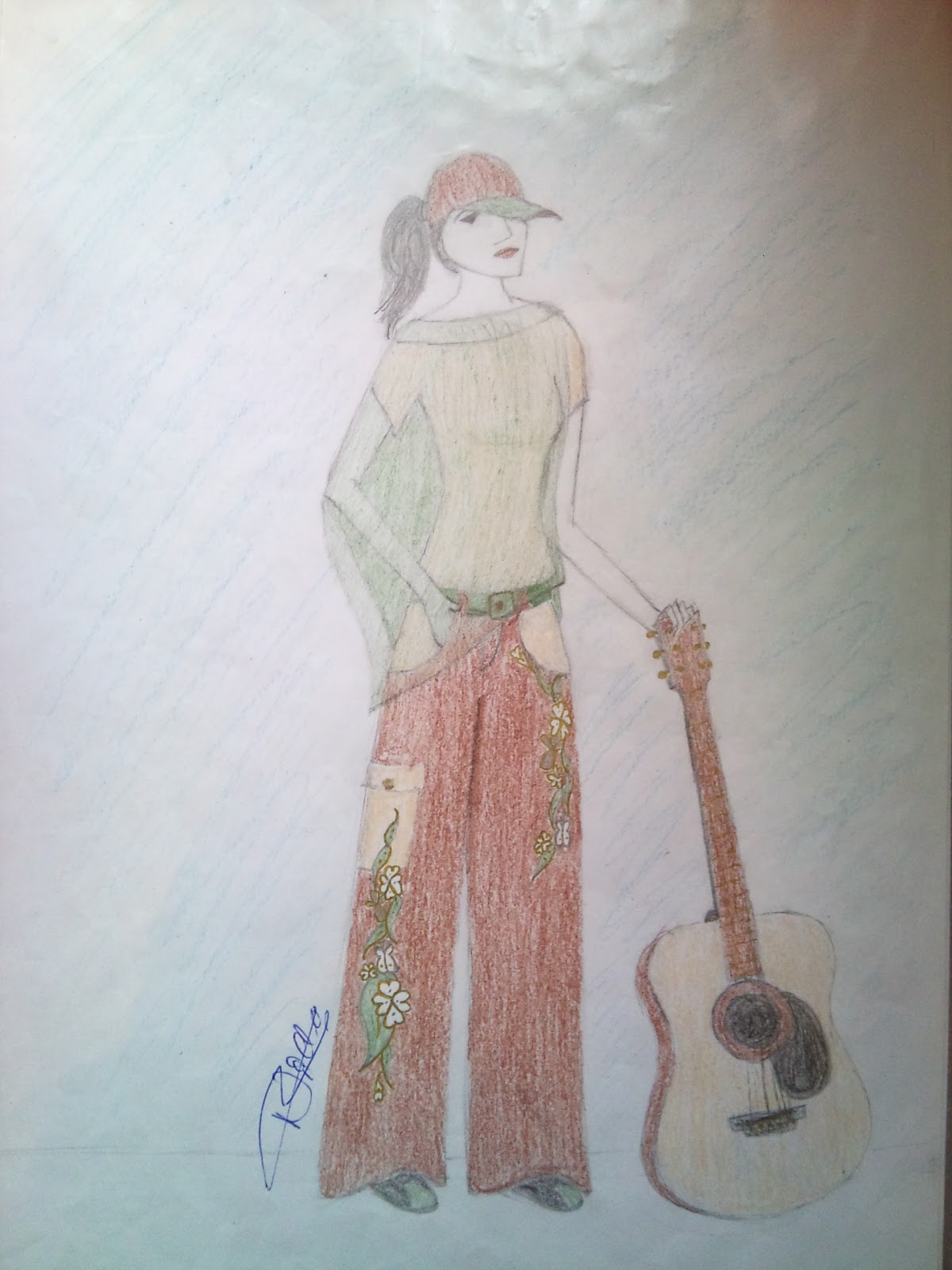
As I was rummaging through the stack of folders under my desk, I found my little black portfolio with all my good sketches in it. Then it occured to me that though I write about all sorts of things on this blog, I've never mentioned my drawings. So I decided to take photos of them and put up here for your pleasure and scrutiny.  Mind you, I've never taken a single drawing lesson in my life (any ability I have to draw, I've inherited from my father), so don't expect to find anything of great artistic genious or with any proffessional quality. 

Of course, given my obvious obsession, almost all my sketches feature characters from my own written/planned novels or stories written by my friend, Codename: Pixie. By the way, this is only a small selection of my drawings. I still have many more tucked away between the plastic pages of my display-file. (Make sure you click on the pictures to see all the minute details.)

1) Meet Nabiha, the main character in Life in Conversations (previously known as 'the Big One'):

2) The following drawings are characters from a quartet of fantasy/fiction novels that have been thoroughly planned but not yet written. Essentially, my drawings are of one model who's trying on the different out-fits that I would imagine my characters dressed up in at some point of the book. They're really just to help me get a feel of the characters and help me when it comes to the more descriptive pieces (which I'm not all that good at writing, in my opinion):
Chronicles by Anamika  Book 1: The Legend of Sharon
Chronicles by Anamika  Book 2: The Legend of Eadah
Chronicles by Anamika  Book 3: The Legend of  Buckles
Chronicles by Anamika  Book 4: The Legend of Sirene
3) the next picture is of drawings I'd originally done for my friend Pixie, some 6 years ago now. She was writing a trilogy about these three witches. She had described her characters to me and asked my to make some sketches. I think that after months of planning, she gave up on the project. But I still like her concept and the pictures:
   
4) Here are some more characters, portrayed by the same one-eyed model (Aside: I always seemed to get the second eye wrong so I gave up in trying to draw it right and from then on gave everyone side-poses) 
Imaan Saeed, from a book that does not have a title yet. Ironically, I've also written quite a lot of this story too.
A few more random assortment of characters from different novels/stories
5) The last thing I'm going to add here are some doodles I use to make at the back of my note-books, while sitting in exceptionally boring classes (during Sixth Form) or lectures (during my 1st year). I haven't made any new doodles in years now. I guess it was a phase I grew out of. (Aside: I also had a phase of writing any song lyrics or poetry that I could remember off the top of my head in to the back of my class-work books. And I always wrote them up-side down):

If I were ever to give a title to my doodles, this one would have been called 'Thoughts that Flow' 


These two are pieces from a much bigger drawing but I couldn't get the whole thing to fit into a single picture in my camera without compromising the detail. And with this piece, it really is about the detail rather than the bigger picture. So I decided to just photograph my favourite bits.


Well I hope you enjoyed this not-so-impressive display of my meagre skills. Let me know what you think and if you want more 'Life: as I see it...' blog posts.

Nida