To begin

In the Name of Allah, the Most Gracious, the Most Merciful
Showing posts with label Poetry. Show all posts

Tuesday, 14 May 2013

Poetry Inspired by Literature #1

Dear Reader,

If you love poetry, then I have a small surprise for you. A recitation of one of my favourite poems, written by yours truly. Enjoy:


It occurred to me during the editing that "sing-songy" isn't an actual word. But meh *shrugs shoulders* I have poetic licence. 

Anyway, click here if your interested in owning a copy of the under-appreciated Tale From the Perilous Realm. Plus, you must let me know if you want to hear more poetry inspired by literature,  and don't forget to subscribe to my youtube channel (which, long ago, belonged to my little brother). 

Nida


Friday, 25 January 2013

(a delayed) Resolution

Dear Reader,

I had planned to post this on the 1st of January, but unfortunately virtual punctuality has never been one of my strong points, as you may have noticed. Anyway, here is my New Years' Resolution:

In the New Year’s firework harmonies
I hope that these next new days   
Will bring with them some new memories,
That’ll hopefully completely wipe away
These oppressive melancholy skies
That seem to have clouded over my life,
The constant rain that are tired tears
That don’t deign to fall from my eyes.

In the new year, a new sun
A new sky and a new moon
A new perspective for one
A new page to write soon.
New goals to be set.
New words bring new thoughts.
New experiences to regret,
New roads for us to tread.

So momentarily frozen on this brink
I pray that this next new year
Has written in its own dried ink
For me, a better fulfilling career,
And brings us more rhymes, more stories
More laughter to be shared,
More faith, imaan and less worries
And more chances for us all to be weird.

Happy New Year 2013, my dear Reader.

Nida

P.S. - I just noticed that my blog views have crossed 10,000. Thank you. You cannot possibly know how good feels to see that my virtual voice has been heard. 

Sunday, 1 July 2012

six Styles of Writing, and Me

Dear reader,

1) When is comes to writing - a thing that I do a lot of - the easiest form for me is, believe it or not, poetry and verse. Subhanallah, sometimes I find that even my thoughts are following some sort of rhyme scheme or meter, trochiac pentameter (with a lot of causurae) seem to be my subconcious' favoured style. (Aside: if you didn't understand anything from the last sentence, click on the links or over here.) When I confessed this to my mother the other day, she gave me such an odd look, as if I was a person she didn't recognise. Kind of heart breaking, given that she is the person I love second most in the world. But, in order to show you, dear reader, how natural poetry is to me, I present to you a poem that I wrote about Writing Poetry: 

Sometimes the most beautiful things
Are those with no inherent cause
Are spontaneously inspired
A single thought that brings
Words upon words without a pause.

So that is when these poems
Emerge and grow out of my brain
They take on life and flutter around
And align like gems upon a chain
But in my mind they cannot remain,

So I cease and caress the words
Nurture those seeds into a stem
Then my pen begins to caper
As I coax the words onto paper
That was bland and lifeless without them... 


2) The next style of writing, that I suppose I'm modestly good at, is description, in particular scenic description.I believe that description forms the majority of a piece of fictional writing. Without it, the piece would be only half-imagined and only half-conveyed. I know a lot of people who struggle with writing description. I often struggle with it myself. For some people, it's difficult to take exactly what they see in their minds and put words to it. For that, I recommend reading a dictionary and thesaurus, keep one close when writing or try thefreedictionary.com. For me, where the problem mainly lies is that my descriptions become far too long and wordy. Trust me, this is a BIG problem, because then the reader either loses interest or gets lost in the convoluted sentences. Which is the last thing any writer wants. And also, it diminshes the power and meaning of what we're trying to say. Here is a piece from Life in Conversations that, ironically, I struggled to get just right.    
She sat there,in her comfy corner seat, gazing out through the right-angled French windows; the precarious ones that over-looked the front of the house. Today she was looking out onto a silent Saturday-morning street. The summer sun causing everything to radiate with a warm glow. As she watched, a strident gust of wind swept through the yawning trees, pulling petals away from blossoms and across the sapphire sky, so that they resembled snow falling upwards. It was a perfectly inspirational moment.
Yet Nabiha’s normally spry pen hung over the page, stalled mid-sentence.
So she just sat there, her face serene, her skin soaking up the sun, her hair swathed over her neck like a blanket of silky scarlet-brown flames. Her shinny new note book lay open in her lap, with only the first page and a half filled with stunted-but-serpentine scribbles. The shaky tapping of her foot was the only indication of the frustration pent up inside her. Her brain sprinted and scrambled through hundreds of possible solutions but none of them fitted comfortably, seamlessly into the dilemma she had created. She was stuck. 

3) Then comes dialogue. I love to read dialogue. I love writing dialogue even more. Probably because it allows  the writer to reveal a person/character's personality without saying banal things like 'she liked to read the news' or 'he was witty'. Also, dialogue is one of those places where, as a writer, I can explore and develop characters and their relationships. Most of the time, when I'm in the flow of a conversation, I find that it can lead me and my characters to places I had not realised/planned, Alhumdulillah. I'm actually, at the moment, experimenting with dialogue within poetry, since I've finally begun working of my epic ballad(which I talk about here). It's called The Legend of Sirene and is the fourth "book" in fantasy quartet Chronicles by Anamika. Here's a sample from the first chapter: 

“I am one of the Sultan’s elite guards.
What you’re doing could be seen as treason.
Meddling in my mission will leave you scarred.
So it’s time for you to find your reason.”
That’s when Conla felt a prick on his chest,
And saw the knife she had pulled on him.
He had to admit, he was quite impressed,
And his language she had spoken to him!
He faced her fully, her arm he held tight
So that she could not try to escape him,
Though, he had not the will or strength to fight.
Asking how she knew his tongue, on a whim.
“How and what I know, is my own business,
Now please, will you kindly let go of me.”
“I cannot, for that I ask forgiveness.
But I must take you to MannCarh, you see.”
At his words, her round eyes were all ignite,
She suddenly stopped struggling to be freed.
Overcome by an idea so very bright,
Those pretty eyes, shone with something like greed.  
...

Please, please, dear reader, let me know what you think. I really need feedback on this to see if my experiment is working well or not.            


4) I suppose the next style of writing for me, has to be informal, non-fictional writing, like this blog or e-mails/comments to friends. I really enjoy this sort of thing because here I can just be simple-old  me, just someone who is speaking thier thoughts, if not out loud, then in at least in virtual ink. I hope you enjoy reading my blog as much as I enjoy writing it. And even if you don't, it okay because your opinion on this probably won't stop me from writing, though I might try harder to improve.
  

5) Truth  be told, I'm pretty bad at writing action pieces where there is alot of movement and snap decision making. I think that this maybe because actions are not a verbal/wordy thing, and are much better seen than read. Take comic books, for example. They are well known for their superheroes and action-packed story lines mainly because they are so visual. In a comic book, you don't expect to find a long debate on the purpose of life and love, using metaphorical examples that hold little true meaning. But you can get action in novel form and, more often than not, it's vital to the story line. As I'm just beginning to realise, myself. Before, most of my novel ideas avoided action, preferring dialogue and conversation as a means to an end. But the fantasy quartet that I just spoke about, requires a lot of action. There's wars, spies, demons, pirates, chase scenes, flying dragons and hand-to-hand combat involved! So, yeh, I'm attempting to write action, but taking slowly, one step at a time. As an example, I give you the opening paragraph of the first novel in the quartet, called The Legend of Sharon: 
That regal buck had no idea what was coming to him, as he sipped away at the stream, his branching antlers skimming the water. Out here in the foothills of the CahnineCarh, a tall mountain range in the southern lands of MannCarh, the green woodland rang with its own music, oblivious to all that went on in the world at large. And as Sharon nocked an arrow in her long bow, she too was oblivious to everything but the buck. She held her breath, took aim, and let it go as the arrow flew from her fingers, and straight into the throat of the animal. A quick and painless death was her preferred style... 

6) Yet the style of writing that I am the worst at, is the one I have to do most of all: non-fictional, scientific/medical writing. It is the antithesis of poetry. And I absolutely hate it. My words don't flow out easily like they do with all the other styles. It just does not come naturally to me, for some reason. I have plenty of friends who can write fantastic scientific treaties and earn the best marks, whereas I'm always struggling to scrape out the right words from my mind. And I've been told by my professors an unaccountable number of times, that my writing is just too "flowery" or "unscientific" or "round-about".   

And really long essays are the even worse, because I quickly lose focus and my mind ends up wondering towards my next poem-in-the-making or an idea for a blog post (in fact, this is exactly what I'm doing at the moment). I think this might be because, scientific writing is just so bland and clinical; you have write very to-the-point sentences, bound in rigid structure, with no space for creativity. I'm not saying that scietific writing itself is bad. It is very important in this modern world of constant innervation. And I greatly admire those who can write scientifically and do it well. Probably because it is something that I can't manage to do. It's something that just does not sit well with my vibarent and flowing personality.

I truly have know idea how I've managed to get through medical university and to have done well! To have almost completed an MSc!! Sometimes I can't help thinking that maybe there are two different Nidas existing in this one body. One that is calm, studious, religious and shy; who wants nothing more than to curl up with a good book. She's the 'Nida' that most people meet on a daily basis. The other seems to be quite crazy and cheeky and loud and creative; who wears bright colours on dull days and wants to run around in green fields and empty beaches. But most of all, loves to paint, sketch and write about the made-up things she sees in her mind.

How they two seem to co-exist so harmoniously, is a mystery to me.
Nida 

P.S. - Please don't forget to tell me what you think about my experiment. You can do this by clicking on the comments bottom below. Thank you. 

Wednesday, 27 June 2012

Sonnets

Dear Reader,

A few weeks ago, in an attempt at procrastination, I decided to reorganise all my bookshelves. If you have been following this blog for some time, you'll understand what an immense task this was. For your interest, dear curious reader I will, once again, map out the arrangements of my books with photographs, but not today. 

Today, I want to write about something I found under a pile of books from my bygone days, when I used to study English Literature. It was my old copy of Shakespeare's Sonnets:


I don't know why this book in particular piqued my interest. I had devoured the entire thing when I was 14 and just beginning to dive into marvellous but murky waters of metaphors and imagery. Those poems had fuelled my imagination greatly and inspired me to write, even though, I have to admit, I did not understand most of the meanings behind what he had written. My love for the poems was based almost entirely on their literary value. 

There was something about finding those poems now, that felt providential. As if, Allah (swt) knowing my current dismayed attitude towards poetry and creativity, wanted to encourage me to carry on writing. By once again providing me with something that had once so inspired me, Allah (swt) in all His guiding wisdom, wanted to remind me of my love for poetry. And so in the time I usually leave for fictional reading (i.e. just before I go to bed), I have been re-analysing each sonnet individually now, with a much more aged and, hopefully, wizened mind. Here is an example:


I thinking that, at least the first 10 or so sonnets, are written from the perspective of a once-beautiful man. And now he is also looking through the eyes of age and wisdom, warning his young and extremely handsome son/protégée about the follies of vanity, of how physical beauty is superficial and will fade with time. And underlying that, there seems to be a plea, for the beautiful youth to pass on this beauty that once belonged to his mother; pass it on to his own children if, like the poet, he wants this beauty to persist after his eventual but inevitable death.        

I know, I know! There's a big whole in my interpretation. The actor who went by the name William Shakespeare didn't have any sons. But then again, I never really believed that he was the true author of these magnificent poems and plays anyway. There are just too many obvious pieces that don't add up. Alas, but this is a debate for another time. I've added here Sonnet 2 for your perusal, dear reader. Let me know what you think of it and my interpretation.     

When forty winters shall besiege thy brow, 
And dig deep trenches in thy beauty's field,
Thy youth's proud livery, so gazed on now,
Will be a totter'd weed, of small worth held:
Then being asked where all thy beauty lies,
Where all the treasure of thy lusty days;
To say, within thine own deep-sunken eyes,
Were an all-eating shame and thriftless praise.
How much more praise deserved thy beauty use?
If thou could answer, "This fair child of mine
Shall sum my count, and make my old excuse,"
Proving his beauty by succession thine!
           This were to be new made when thou art old,
           And see thy blood warm when thou feels it cold. 

I've also added here some quotes from some of the other sonnets that I thought were just too amazing to keep to myself:

Beauty's effect with beauty were bereft, ~ Sonnet 5


Thyself thy foe, to thy sweet self too cruel. ~ Sonnet 1

Thou art thy mother's glass, and she in thee
Calls back the lovely April of her prime:
...Despite of wrinkles, this thy golden time. ~ Sonnet 3


That thou among the wastes of time must go,
Since sweets and beauties do themselves forsake,
And die as fast as they see others grow; ~ Sonnet 12


Music to hear, why hear'st thou music sadly?

Sweets with sweets war not, joy delights in joy. ~ Sonnet 8


However, since we are speaking of sonnets and age and maturity, I thought I'd present you, dear reader, first one of my very first sonnets (that I wrote when I was about 15) and then, of course, my latest one.  

Flight

To lift my wings, and to fly,
To see all these cities bare,
To watch people boldly lie,
To feel the rush of the air.
To see things born, see them die,
To glimpse beauty and despair,
To reach the top, touch the sky,
To race along with a mare.
To witness those, in pain, cry.
To sight tender love and care,
To view people steel and buy,
To sense scenic freedom so near.
To lift my wings and to gloriously fly,
No day could be more fair.

***

Thoughts on a Plane (7th February, 2012)

The soft white landscape in the sky,
I look on to as I hover by,
And remark on the hills the clouds form,
Or the black mountains created by a storm,
Or wispy ones that are a steamy stream
Lit asunder by sun-light’s full gleam.
They travel the world, these fluffy Bedouins.  
With all their hidden precipitous denizens.
So as I journey above, this city of pearl cotton
I watch as the light around me, slowly softens.
Until nought but an orange-red ribbon is left,
Gracing this perpetual horizon, right to left.
Now awe and breathless is how I feel,
            As before my Creator I prostrate and kneel.  

I just realised that, despite the fact that these two sonnets were written 7 years apart, and that I have written many other sonnets concerning all sorts of topics in between, these two in particular seem to share a theme: gazing out over the world, from above.

And with that thought, I shall say goodbye.   
Nida    

Saturday, 10 December 2011

Perspective, Passion & Purpose

Dear Reader,

Though I only have nine days left before the deadline of an assignment and two exams, I thought I'd take some time out to share this video with you. Mashallah, I was really blown away by the confidence and talent of this sister. I hope she impresses you too and inspires you, as she has inspired me, to change and be the change towards a greater cause. Enjoy:


I'd love to read your thoughts on this. Leave them in the comments section below.
Nida

Sunday, 2 October 2011

Awesome Autumn

Dear Reader,


I realise that this post is about a month late :-S. I'd like to claim that this is because I've been really busy (a viable excuse since my mother is off on holiday to Pakistan and left me in charge of the house and my brothers) but the truth is my mood has not been at its perkiest of late and I did not want to "rant" on my blog or write a heart-breaking sob-story. I don't usually wallow away in self-pity and I'm sure that you, dear reader, would not want to hear about my small dive into it either.   

So now, on to the main topic of this blog: autumn is my most favourite time of the year. I usually don't go into in-depth accolades to abstract things or seasons. But right now, as I gaze out of my window into the garden, or as I was down the streets or through a park, I can't help but contemplate and be in awe of nature during this time of year. 

What I like most about autumn are the colours: the greens of summer transitioning into browns, orange, red and gold. And this transition seems to be everywhere I look, and not just in leaves. Say, if a year was a day; then night will be winter, spring will be during the sunrise and morning, summer would be symbolised in the noon-day sun and, of course, autumn would be a sunset. 


And a sunset during autumn itself is something that captures the imagination. As the sun makes contact with the horizon, it sets the sky ablaze in oranges, reds and pinks. And when this light filters through the semi-transparent autumn trees, the whole place is awash with warmth. SubhanAllah. To me, everything about autumn is warm: the colours, the clothing, the temperature - which is neither the heat of summer that requires us to squint our eyes and hide indoors with the AC nor does it have the chill of winter. Even the rain, as it falls from the sky, often holds are warm quality. I like warm.     


There is a really well known poem by John Keats, that I think captures the transition and slight sadness of Autumn quite well:
         
                          To Autumn


                                   1.
    Season of mists and mellow fruitfulness,
        Close bosom-friend of the maturing sun;
    Conspiring with him how to load and bless
        With fruit the vines that round the thatch-eves run;
    To bend with apples the moss’d cottage-trees,
        And fill all fruit with ripeness to the core;
            To swell the gourd, and plump the hazel shells
    With a sweet kernel; to set budding more,
        And still more, later flowers for the bees,
        Until they think warm days will never cease,
            For Summer has o’er-brimm’d their clammy cells.

                                  2.
    Who hath not seen thee oft amid thy store?
        Sometimes whoever seeks abroad may find
    Thee sitting careless on a granary floor,
        Thy hair soft-lifted by the winnowing wind;
    Or on a half-reap’d furrow sound asleep,
        Drows’d with the fume of poppies, while thy hook
            Spares the next swath and all its twined flowers:
    And sometimes like a gleaner thou dost keep
        Steady thy laden head across a brook;
        Or by a cyder-press, with patient look,
            Thou watchest the last oozings hours by hours.

                                  3.
    Where are the songs of Spring? Ay, where are they?
        Think not of them, thou hast thy music too,—
    While barred clouds bloom the soft-dying day,
        And touch the stubble plains with rosy hue;
    Then in a wailful choir the small gnats mourn
        Among the river sallows, borne aloft
            Or sinking as the light wind lives or dies;
    And full-grown lambs loud bleat from hilly bourn;
        Hedge-crickets sing; and now with treble soft
        The red-breast whistles from a garden-croft;
             And gathering swallows twitter in the skies. 


And I think that I'll leave you, dear reader, with the most recent additions to my Autumn reading list, well that is with the exception of Sweetly (which is due to be released in the UK some time in October): 

  1. Just Like Heaven by Julia Quinn
  2. The Female Brain by Luann Brizendine
  3. The Grimm Legacy by Polly Shulman
  4. The Princess Bride by William Goldman
  5. Ruby Red by Kerstin Gier
  6. Scorpio Races by Maggie Stiefvater
  7. Inheritance by Christopher Paolini
  8. Sweetly by Jackson Pearce
  9. Idylls of the King by Lord Alfred Tennyson (LAT)

Nida

ETA - I've tried but I'm not sure how to fix the highlighting of the poem and other bits. If you know how, then please let me know in the comments section below. Thanks.

Monday, 29 August 2011

a Conversation in Rhyme

Dear Reader,

My friend Codename: Pixie and I just had an eerily interesting conversation through text messages. Actually it's a conversation that's been going on for days now, switching from phone calls to text messages and back again. But when this conversation  became poetry, I know not. But there is a piece that I particularly like, that I have named Smile (©2011). The reasons and inspiration behind these poems is too long and complex to go into now. However, I have decided that I would like to share them with you, lucky Reader:

I started out like this... 

"Where is your smile, dear?
Has the sadness become too much to bear?
Has the burden of the last seven years,
Destroyed your youth in these final tears?
Where is your smile, dear?
The light in your eyes seems to disappear
Torn up your innocence it has, I fear
And left your soul in this horrid disrepair
Where is your smile, dear?
A bright sun has risen, the day is fair
There's hope for the future, don't despair
Will your smile ever come back, my dear?"

...and so Pixie's reply was her version of the poem...
  
"One day, your smile shall return, my friend.
Life is resilient, with ups and downs till it's end. 
One thing is certain,
For me your God's send
With whom I shall argue and laugh and pretend.
I will chase away all your unwanted fiends.
One day, for sure, your upside down smile will mend."

...to which my response was...

"You bring a smile to my face,
A giggle into my voice.
Tears leave their trace,
But I still have a choice.
I will love and laugh and enjoy my life,
And not dwell on past struggles and strife.
I know that there will always be things that I rue,
But there are just not enough hours in a day.
So as long as I have a friend like you,
A smile will never be too far away."


I hope you enjoyed that. I would love to write more and share more, however I need to go and do some emergency grocery shopping. 

Nida


ETA - I forgot to Thank Pixie for giving me the permission to post her poetry on my blog. So Thank you Pixie dearest.

Monday, 20 June 2011

this Literal post of Poetry

Dear Reader,

I'm sorry this post has come so late
but it has taken me some time to make.
You see, I wanted to do something distinct,
challenged myself to follow my instinct.
So I began to write in this very rhyme,
did my best to keep the meter in time,
resulting in this literal post of poetry.
You, dear Reader, ask what inspired me?
Tales from the Perilous RealmIt's because of this amazing chapter I'm reading
in this book, through which I'm currently speeding,
it's called Tales from the Perilous Realm
with short stories and poems that overwhelm.
Written by Tolkien, an author of repute.
To him I send my most awed salute.
He once wrote a story for his second oldest boy,
to console him when he lost his little dog toy.
Finally being published under the name Roverandom,
displaying fatherly affection, now seen so seldom.
This book's similar to The Tales of Beedle the Bard
and, I guess, for the same reason it holds my regard.
To end, I thought I would share a poem or two,
but I've realised that I have nothing much new.
Well, at least nothing good enough for you to read,
so I'll give you something else to satisfy your literary need.
It's an extract from the poem, The Sea-Bell
also by Tolkien. It reads quite well:

"I heard a sea bell swing in the swell,
       dinging, dinging, and the breakers roar
on the hidden teeth of a perilous reef;
       and at last I came to a long shore.
White it glimmered, and the sea shimmered
       with star-mirrors in a silver net;
cliffs of stone, pale as ruel-bone
       in the moon-foam were gleaming wet.
Glittering sand slid through my hand,
       dust of pearl and jewel-grist,
trumpets of opal, roses of coral,
       flutes of green and amethyst." 

It's a beautiful way of describing indeed,
a beach and sand and green/purple sea-weed. 
A brilliant way of capturing the imagination
Inspiring, in spite of my aspiration.  
I believe I now have more poetry to write, 
and Inshallah, bring my writing to a new height. 
I hope to meet you once again in a few days,
But now it's time for us to part our ways. 

Nida  

Sunday, 10 April 2011

a Poem of Importance

Dear Reader,

It has come to my attention that France's ban of the burkha/niqab will be coming into effect this Monday, despite many protests against this. Rather than going into a lengthy sermon on how incensed I am by all this, I thought I'd share a poem with you. It's not directly related to the ban, but I thought it expressed my opinions on the subject quite well. I hope it makes you think, but also enjoy:

My Hijab
2010
  
My rightful Dignity.
Modestly t                 hrown over
my head,                                     a cover
for on                                                 ly one  
to dis                                                      cover.
It’s Fre                                                         edom
in a cl                                                            oth of
pure Sim                                                            plicity,
my hija                                                               b is my
Inte                                                                         grity.
I’m only                                                                 judged
by what                                                              I say and
 what I do,                                                        rather than
the way I                                                       look to you.
A symbol of                                                  my Identity,
it means such a                                     great deal to me.
A form of worship it                      truly can be. I wonder
why some people don’t understand, isn’t freedom of expression
a form of Liberty? Yet they chose to deny me, this common courtesy,
constantly telling me, that I’m oppressed, repressed, depressed. Telling me that I
need to be freed. Freed by commercial ideas of Beauty, a doll of desire, what they call womanly.
Outward appearances seem to rule their ideas of Civility and Popularity. Don’t they know that it is what’s inside that counts. That one day we’ll all be called to account, for all our deeds and 
Impropriety. Why can’t they see, that this pathway is the life I chose for me?
 And though I know people still talk and glare, question my Sanity,
I will always stand by what I heartily believe.  
Because this is my Hijab,
that I wear so
proudly.

Nida

Monday, 24 January 2011

poetry, Again!

Dear Reader,

In my last poetry post, I completely forgot to mention Lord Alfred Tennyson among my favourite poets. I admit I hadn't read much of his poetry back when I wrote the post a few months ago, but I recently acquired a copy of his selected poems and I find that my opinion of his poetry is now much improved ;-).

So far my favourite has to be The Lady of Shalott. It's a brilliantly flowing and breathtakingly beautiful poem, but it's also quite long. So I only recommend that you read if you're really interested. It's basically about this young lady who has spent her whole life trapped in a tower on the small island of Shalott, that lies in the middle of the river that leads to Camelot. As things go, she is cursed, the poor girl, and can only watch the world go by through a mirror. One day, in that mirror she sees Sir Lancelot riding towards Camelot and falls instantly in love with him. I suppose he's meant to be some ultra-handsome-dude that girls are always swooning over. So anyway, the young lady of Shalott decides to risk it all and venture forth to Camelot on her boat. However, by the time the boat reaches Camelot, they only find the poor girl's dead body in it. And the irony of it all is that, when Lancelot finally sees her, he thinks that she was quite beautiful. *Sigh*.
The Lady of Shalott by John Williams Waterhouse, 1888
But this poem really makes me think about how we should take action no matter what our circumstances. Rather than waiting for our knights-in-shining-armours to rescue us (who, by the way, may not even know we exist), and rather than just watching the world on our T.V. and computer screens, we should go out there and actually see it for ourselves.      

Anyway, this post without any real poetry. So here is my favourite excerpt from Merlin and Vivien from Idylls of the King by Tennyson:

'“In Love, if Love be Love, if Love be ours,
Faith and unfaith can ne’er be equal powers:
Unfaith in aught is want of faith in all.
“It is the little rift within the lute,
That by and by will make the music mute,
And ever widening slowly silence all.
“The little rift within the lover’s lute
Or little pitted speck in garnered fruit,
That rotting inward slowly moulders all.
“It is not worth the keeping: let it go:
But shall it? answer, darling, answer, no.
And trust me not at all or all in all.”'
By the way, Idylls of the King is an novel-length-incredible-long poem made up of some-what-long poems that chroniclize the adventures of King Arthur and his friends.

And though I cannot possibly compare myself to master poet, such a Lord Alfred Tennyson (who, by the way, was the Poet Laureate for England from 1850 till 1892, when he died), I leave you now with a few more of my own poems:

Divine Loneliness
2010

Under a liquid-grey evening sky
When night is never more so nigh
                                                                 
From these closed eyes falls a watery streak
No one wants to know of another’s grief

Never more alone than when in a crowd.
Yet faith leaves me so little room for doubt
That this clustered solitude could ever be complete
When prostrating myself at His sublime Feat

Since human comfort always seems to fail
Only His noble words give me space to heal
This pain those people unknowingly inflict
Belief stitches every wound and every snick

And now tears bring on an overwhelming peace
Ever more near to my heart, is this ephemeral ease.  


Hi, (an e-mail) 
©2008

Hi,

Just writing to ask how you are doing?
Haven’t spoken to you in quite a while.
Just wondering if your life is still blooming,
And if, on your lips, there’s still that smile?

My life in truth is pretty much the same,
A mixture of family, study and poetry.
Constantly, things to be done remain,
Not even enough time for a single memory.
And yet, I feel there’s too much satiety,
Maybe because of the routinely pattern of day.
But don’t give me that look, I don’t need pity,
Sometimes I prefer to have things that way.

Do you remember that trip that was so serene,
Those mountains where we almost lost my brother?
But enough about me, how many years has it been
Since the last time we had seen each other?
We should meet up again sometime soon,
Maybe we’ll have a coffee and a good conversation.
But that’s only if I can make some time out of this gloom,
There’s nothing better than some anticipation!

So I’m eagerly waiting for your reply,
To me that is something you cannot deny.
But now it’s time for me to say Good-bye.

Nida

Thursday, 25 November 2010

Some Reviewing Part 2: Tam Lin

Dear Reader,

Lately I've been reading a lot of long poems and a lot about narrative poetry, ballads in particular. You see, for some years now, I've wanted to write my own epic/ballad; a sort of challenge to myself, though it had been a vague idea of something that I would do, some time in the future. But now I've finally got the story that I want tell through verse. I've got the characters, the setting, the plot and we can't forget the "bad guys". But, like any good story, before I actually start writing the epic/ballad, I need to do a bit of research. In this case, about form and structure of specific narrative poems.

Tam LinAnd that, my dear reader, is how I stumbled across the 16th Century Scottish-borderland ballad, "Tam Lin". But as it turns out, a popular fiction writer, Pamela Dean, has written a modern re-telling of this old ballad. So of course I jumped at the chance of reading it.

It started off all well and good and interesting. However, for the first three quarters of the book, it read less like a modern re-telling of an old folklore ballad and more like the author's account of university life. And though I don't mind reading the later and greatly enjoyed her poetic language and discussion of great literary writers and their works (espeacially her take on Hamlet); more often than not, I found myself wondering when the magic and faeries would come in. At one point I became quite hopeless in my search for a spark between the two main characters, Tam Lin/Thomas Lane and Janet, i.e. the beginning of the story from the folk tale. And it is precisely because of this delay that some of her rambling descriptive pieces, though linguistically beautiful, became a bit of a nuisance to read. 

Nevertheless, it wasn't until after page 266 (more than half way through) that I began to spot some overt hints to the actual story of the ballad. (But when it truly began, the whole thing was resolved in less than five pages - make of that what you will.) So "all's well that ends well", right?

One thing's for sure, this book has definately got me interested in literature-that's-more--intellectually-challenging again, which is a bit of a move from quick-enjoyable-fictional-reads-that-don't-require-much-brain-power that I had been reading lately. But on the hole, though the characters didn't make a lasting impression on my heart, I still found it to be an intellectual pleasure to read, and would probably find myself revisiting it sometime in the near future.

As for my own epic/ballad, I'll keep you posted on any developments.

Nida

P.S. - sorry no video today. Maybe next time, if any thing significant pops up. 

Thursday, 4 November 2010

Poetry Post

Dear Reader,

It's the first week of November and because I said that I will be posting regularly now (same as before - once a week) I decided it was high time for another blog post. Problem is, I don't really have anything new to say. I've  been trudging through the same, albeit exteremly interesting, book for the past 2 weeks: Cranioklepty: Grave Robbing and the Search for Genius by Colin Dickey. So I'm not even able to write a review yet.  
In the end (which was about exactly 7 minutes ago!) I decided to write about one of the things I'm quite passionate about. Poetry. If you, my dear reader, have not even the tinyest bit of interest in poetry, then I give you premission to not read this post. Don't worry, I won't hate you for it (this is being written with a benevolent smile on my face, just in case you don't believe me).  


As far as hobbies go, I think poetry is a good one to have. Even the Prophet Muhammad (SAW) was a fan. In Women around The Messenger, by Muhammed Ali Qutb, it states that the Prophet (SAW) "did not compose poetry, but as an Arab, naturally loved refined and truthful poetry, the sort that avoided exaggeration and triviality in words and meanings ... [the Prophet (SAW)] appreciated the positive impact that poetry can have on the mind." In fact, one of his (SAW) favourite poets was a women called Al-Khansa, whose best work was a beautiful eulogy that she wrote on the death of her brother, Sakhr. Which reminds me, in an earlier post I mentioned my favourite stanza from Percy Shelley's poem To a Skylark. Again, despite the differences in time and culture, his words seem to speak true, where our "sweetest" poems are those that are derived from the "saddest" thoughts and experiences.
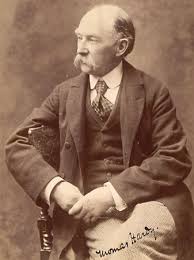

But as far as favourite writers go, there is always Thomas Hardy; better known for novels like Tess of the d'Urbervilles, The Mayor of Casterbridge and The Return of the Natives, (all of which I have read, by the way) set in a semi-fictional place called Wessex. But I still like his poetry the best. It's so often depressing but mostly meaningful and exquisite. My favourite is the poem Convergence of the Twain but it's a fairly long poem. The Darkling Thrush is my second favourite and is a much shorter poem:


    I leant upon a coppice gate
    When Frost was spectre-gray,
    And Winter’s dregs made desolate
    The weakening eye of day.
    The tangled bine-stems scored the sky
    Like strings of broken lyres,
    And all mankind that haunted nigh
    Had sought their household fires.

    The land’s sharp features seemed to be
    The Century’s corpse outleant,
    His crypt the cloudy canopy,
    The wind his death-lament.
    The ancient pulse of germ and birth
    Was shrunken hard and dry,
    And every spirit upon earth
    Seemed fervourless as I.

    At once a voice arose among
    The bleak twigs overhead
    In a full-hearted evensong
    Of joy illimited;
    An aged thrush, frail, gaunt, and small,
    In blast-beruffled plume,
    Had chosen thus to fling his soul
    Upon the growing gloom.

    So little cause for carolings
    Of such ecstatic sound
    Was written on terrestrial things
    Afar or nigh around,
    That I could think there trembled through
    His happy good-night air
    Some blessed Hope, whereof he knew
    And I was unaware


    This poem was written at the turn of the 20th Century: going from 1899 CE to 1900 CE was a big thing at the time! But what I like most about this poem, aside from the vivid and contrasting imagery, is that despite the death of an era, a century, there is still Hope, even for the "old birds".


    For a reason I cannot possibly fathom, I'm not much of a fan of modern poetry, but much rather prefer Victorian, 17th and 18th Century poetry. Some of my favourite poets include William Blake (London being my favourite from Songs of Experience), Robert Browning (My Last Duchess and Love Among the Ruins), Sir Walter Scott (Lady of The Lake and some parts of Marmion), Christina Rossetti (Remember),  Mary Ann Evans/George Eliot (In a London Drawingroom), William Wordsworth (Composed upon Westminster Bridge, 1802 and Daffodils)  and John Keats (To Autumn). You know, I've also noticed that I have a tendency to like poems related to the contrasts, especially between the countrysides abundant beauty and cramp city life, but also poems about Nature in general.


    One of the few modern poets that I do like, however, is Imtiaz Dharker. I came across her work while doing my GCSE's. And though I've read quite a bit of her poetry now, I still think that the following poem is the best one she's written:


    Blessing
      The skin cracks like a pod.
      There never is enough water.

      Imagine the drip of it,
      the small splash, echo
      in a tin mug,
      the voice of a kindly god.

      Sometimes, the sudden rush
      of fortune. The municipal pipe bursts,
      silver crashes to the ground
      and the flow has found
      a roar of tongues. From the huts,
      a congregation : every man woman
      child for streets around
      butts in, with pots,
      brass, copper, aluminium,
      plastic buckets,
      frantic hands,

      and naked children
      screaming in the liquid sun,
      their highlights polished to perfection,
      flashing light,
      as the blessing sings
      over their small bones.


      I've often contemplated over the idea that we privileged humans, more often than not, forget to appreciate the simple but important things/blessings in our lives. There is far too much to discuss on the topic of this modern fanaticism for materialism, too much for this one post. But I think Imtiaz Dharker's poems brilliantly brings a bit of perspective into my everyday equation. That's probably why I find myself repeatedly going back to it.


      Nevertheless, fortunately this modern time is not completely lacking in talent. Take Tim McIlrath for example, from the band Rise Against. Though he's not a technically a poet, his lyrics are akin to poetry. Here are some of my favourite lines:

      from The Good Left Undone:

      In fields where nothing grew but weeds,
      I found a flower at my feet,
      Bending there in my direction,
      I wrapped a hand around its stem,
      I pulled until the roots gave in,
      Finding there what I'd been missing...


      Inside my hands these petals browned,
      Dried up, fallen to the ground
      But it was already too late now.
      I pushed my fingers through the earth,
      Returned this flower to the dirt,
      So it could live. I walked away now.


      from The Dirt Whispered:

      She got down on hands and knees,
      One ear against the ground,
      Holding her breath to hear something,
      But the dirt made not a sound tonight.


      Echoes of songs still lurk on distant foreign shores,
      Where we danced just to please the people that only ask for more,
      So it goes
      But still we give ourselves to this
      We can't spend our lives waiting to live...


      The postcard says wish you were here
      But I'd rather I was there, 
      Holding on to the simple things before they disappear,
      That's what I meant
      But that was then, and this is now
      I'll make it up to you somehow...


      You have to agree, there is something simple but explicitly elegiac and graceful about these lyrics.

      Since I've been writing about poetry, this post would not be complete without mentioning Shakespeare and John Milton. Rather than go into lengthy odes about these two literature celebrities, which would probably bring back your nightmares from high school English classes, I'm just going to present you with some small sampling of my favourite piece of Shakespeare's work.


      Sonnet 130 by Shakespeare


      My mistress' eyes are nothing like the sun;
      Coral is far more red than her lips' red;
      If snow be white, why then her breasts are dun;
      If hairs be wires, black wires grow on her head.
      I have seen roses damask'd, red and white,
      But no such roses see I in her cheeks;
      And in some perfumes is there more delight
      Than in the breath that from my mistress reeks.
      I love to hear her speak, yet well I know
      That music hath a far more pleasing sound;
      I grant I never saw a goddess go;
      My mistress, when she walks, treads on the ground:
         And yet, by heaven, I think my love as rare
         
         As any she belied with false compare. 

      I'll leave it to you, my intelligent reader, to make what you want of these two poems. Aside: from of all the Sonnets that I've ever read in my life, these two are my favourite.
        Anyway, because I've had a few poems published in anthologies here and there, I consider myself a somewhat amateur poet. So here is a treat for you, dear reader: some of my own poetry that has been deemed worthy of publishing:


        Precious Rain 
        ©2007


        Thick pearl grey fluff
        hovering above us
        outlined by white
        where the gold sun dare to shine.
        The thousand tears
        fall from the saphire sky.
        Bitter but sweet
        the wind blows by.
        Confining others
        for me it's no matter.
        Pitter-patter
        and pitter-patter
        the droplets kiss:
        the emerald leaves
        the gemmed flowers
        the paved floors
        for hours and hours.
        It feels so soft 
        upon my skin
        the water beads
        falling within.

        It's all gone
        only some remain
        nestled on petals
        like diamons on a chain.

        Age in Laughter 
        ©2008


        Spring are the tears of the newly born
        pattering down by passing clouds of morn
        with strength to sprout through iced soil
        that which remains of Winter’s toil
        leaving behind the sound of innocence torn,
        Spring are the tears of the newly born

        Summer is the speed of sweat trickling
        casting a shadow little more than trifling
        down the backs of a multitude of flowers
        as the days lengthen, hours by hours
        rich with youth in melodious giggling,
        Summer is the speed of sweat trickling

        Autumns are a drop of ripened browns
        dew in evenings around cities and towns
        there the orange and blazing red of trees
        golden honey stolen from laboured bees
        where wary chuckles hide knowing frowns,
        Autumns are a drop of ripened browns

        Winter is a frigid mask of the pool
        where night is when we all play fool,
        dormant in death nature seems to lie
        time passes in the whisper of a sigh
        a snigger filled with writhing pain
        until Winter gives way to Spring again...


        Aside: Age in Laughter was one of my more obscure poems, written in response to a poem written by my friend Codename: Pixie, called Disappearance of Innocence. 


        I, the Wind
        --> -->
        ©2006


        I am like the cool wind
        on a hot summers day
        I lift your spirit 
        I lighten your heart
        I blow off some of your burden
        while I seductively stroke 
        my finger through your hair
        and then
        I am gone.
        And you try so hard
        to grip me in your grasp
        only to find you can't
        So you try so hard
        to dwell upon those memories 
        linger upon those feelings
        of cool
        while you wait for my return.
        Yet you seem to ignore
        the glass of iced water
        right in front of you
        which can cool you much better than I?


        Like Hamlet 
        ©2010


        Like the sun clinging to the clouded sky
        Before it plunges into the earth,
        I dither on a horizon
        Waiting for my ghost,

        Like the tumultuous sea of North,
        I’m calm and then I soar
        And hidden in my madness
        A pain I had not before,

        Like the wind wafting over a rose
        I kiss my lover’s breath,
        Then push it further from me
        And see it through to death.


        Aside: as you can probably tell, Like Hamlet is one of my more recent poems. I wrote it when I was re-reading Hamlet by Shakespeare. I normally don't re-read plays and much prefer to watch them. But I had just finished reading Ophelia by Lisa Klien, where Klien re-writes the play from Ophelia's perspective (one of the only two female characters in the play). That's why I ended up re-visiting a lot of Shakerspeare's work last year.

        Make sure to leave a comment to let me know what you think of my poems, and if by some miracle you like one of them, let me know which one.


        Nida